
In Armenia, the Russian language today remains the first and mandatory for learning a foreign language. Despite this, the position of the Russian language in the country and its status periodically becomes the topic of heated discussions.
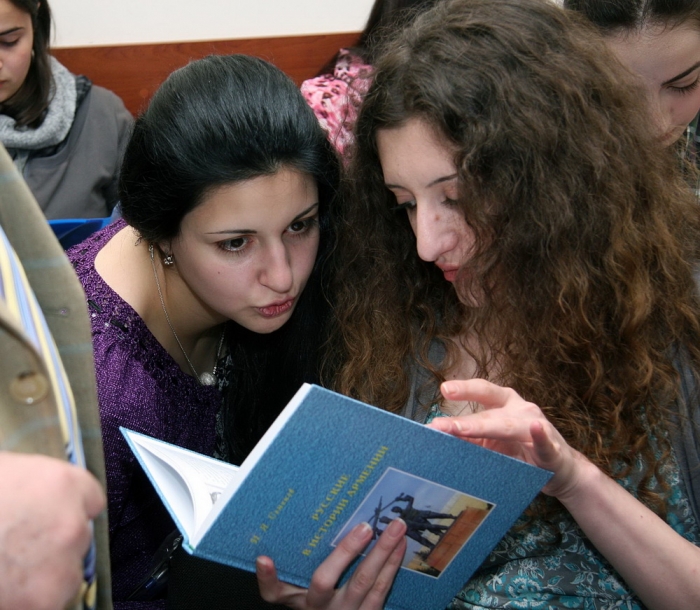
Maria Kalpakchyan graduated from high school in Moscow, but entered the university in Yerevan and now studies as a journalist. She is one of about three thousand students of the Russian-Armenian University, which was opened in Yerevan twenty years ago.
With her, a second-year student, we met in the courtyard of the university. By us, there are groups of students who speak something in Russian, then in Armenian.
“Abroad, of course, English is more important, but if you live in Armenia, even if you have the basics of the Russian language,” Maria says confidently.
With the fact that the Russian nobility in Armenia is necessary, agree standing students. On the question of whether the Russian language should have the status of state in Armenia, the interlocutors react emotionally.
“This is the same as saying that in Russia, apart from the Russian language, all the other languages spoken are supposed to have state status.” No, of course not, and there is no way! “- cuts Maria’s interlocutor, Liza Nazaryan.
Lisa studies as a philosopher. She graduated from the Armenian school, but speaks fluent Russian. The textbooks on which she studies are mostly also published in Russian.
“Since my childhood, I’ve traveled a lot to Russia in the summer.” The Russian language for me is native, almost on par with the Armenian language, maybe even a little more, but I do not belittle the status of the Armenian language, “she explains.
Many people share this mood in Armenia. Despite the wide spread of the Russian language, attempts to question the status of the Armenian as the only state language, cause a painful reaction in the Armenian society.
Today, Armenia is Russia’s faithful ally in the South Caucasus and the only member of the EEA, where the Russian has no official or official language status. In a country with a population of about three million, the Russian language is called home to less than 1% of the population.
But on the streets of the Armenian capital there are often signs in Russian, and, according to official data, more than half of the residents speak fluent Russian.
In the media, meanwhile, periodically there are materials about problems with the knowledge of the Russian language among the population of Armenia and discussions on the possible provision of the Russian language with an official status are beginning to flare up.
“The idea of Russian as a second language in Armenia is constantly being pushed in. It’s like a sausage inside a sandwich – it’s not visible, but it’s there,” says Ruben Mehrabyan, an expert at the Armenian Institute of International Relations and Security.
In July of this year, a stir in Armenia was triggered by the statement of the Speaker of the Russian State Duma, Vyacheslav Volodin, who proposed to consolidate the status of the Russian language as official in Armenia.
He explained this proposal came into force in Russia, a new law that prohibits drivers with foreign rights to work in Russia.
“I can say only one thing: fix the Russian language as official, and then the norm of the law will automatically cover the Republic of Armenia,” Volodin said at a meeting with the chairman of the National Assembly of Armenia, Ara Babloyan.
Presented in September by the Armenian Ministry of Education and Science for public discussion, the separate concept of studying the Russian language only added fuel to the fire and triggered a new wave of suspicion.
The ministry says that the fears of the public have no basis, and the concept itself – for both Russian and other foreign languages - was created with the goal of increasing the effectiveness of teaching, taking into account various methods and experience.
“The main concern was that there was a gradual introduction of the Russian language as a state language … Nobody had such an idea and purpose … In this concept, in the first sentence, what is fixed at the legislative level is written: the state language in Armenia is Armenian, and no one doubts this, “Deputy Minister of Education and Science David Sahakyan.
According to him, the creation of the concept separately for the Russian was in fact due to the fact that the Russian language is the first foreign language that is compulsorily studied in schools in Armenia.
In addition, there is another reason for isolating the Russian language from other languages, for which a separate concept was also developed: the Cyrillic alphabet is used in Russian, and the Latin alphabet in Russian, Sahakyan says.
“Of course, the history of Armenia and Russia is so connected that it is simply impossible to detract from the dignity of owning the Russian language, but knowing the languages, including the Russian language, is a requirement of modern students,” says Ruzanna Sarukhanyan, the 29th senior school located in the center of Yerevan. .
Walls of the corridor and classrooms of the school are decorated with posters in Armenian and in Russian, as well as portraits of Russian writers. A few Russian classes are open at the school, where 109 pupils study – this is approximately one sixth of all students in the school.
According to Sarukhanyan, there was a period when the Russian language intensively left Armenia, but today the interest in learning the Russian language, like other foreign languages, is high.
During the Soviet era, there were both Russian and Armenian schools in Armenia. According to Arshak Sargsyan, Executive Secretary of the Armenian Association of Russianists and Director of the Institute of Russian Literature of RAU, the quality of teaching in them was considered to be better, therefore some ethnic Armenians gave their children to Russian schools.
In the early 1990s, all public schools began to switch to the Armenian language of instruction. This process was rather painful for those Armenians who studied in Russian schools, he says.
“Before the sixth grade, the schoolchildren were transferred to an Armenian school, and they gradually switched to the Armenian language, and those who were older were allowed to finish their studies,” Sargsyan said. “But it was done abruptly, not everyone liked it, but I think it’s correctly”.
Since that time, Armenian public schools have been taught in Armenian, but there are classes where they teach in Russian.
To study in such classes, according to the Deputy Minister of Education and Science, only representatives of national minorities, children whose one or both parents are not citizens of Armenia or those who have studied at least five years in a Russian school, are entitled.
At the same time, Russian takes the place of the first and compulsory for teaching a foreign language, which is taught from the second class. The second foreign language – English, German or French, depending on the choice of the school, is introduced into the school curriculum as early as the third grade.
Meanwhile, Armenian applicants and students are offered training in educational institutions in Russia. According to the Russian Center for Science and Culture in Yerevan, the Russian side annually allocates about 200 state scholarships for Armenian citizens at the expense of the federal budget.
In Armenia itself, in addition to the Russian-Armenian University, according to the Armenian Foreign Ministry, there are seven branches of Russian universities, including the Moscow State University branch in Yerevan.
According to Sarkisian, Russian remains the language of education for youth, and in Armenian universities the number of textbooks in Russian continues to prevail over textbooks in English or Armenian.
But many analysts believe that such a priority of the Russian language as the first and compulsory for studying does not meet the requirements of the present.
Most of the students of Armenian universities continue to use Russian textbooks because of their greater accessibility and insufficient level of English knowledge, Agasi Tadevosyan, a cultural anthropologist and candidate of historical sciences agrees.
Arthur Zargaryan
 Political and economic news with a Baltic accent
Today we are friends with America, but not tomorrow. Today we teach English, but tomorrow we do not. Russia is always near and the Russian language is still very necessary. Armenian youth do not dream about the US, they dream about Moscow …
LikeLike