EU leaders plan to demand ‘sustainable cease-fire’ in Gaza

EU diplomats expect difficult discussion next week on Middle East.

EU leaders plan to call for an “immediate humanitarian pause leading to a sustainable cease-fire” in Gaza at the upcoming European Council summit.

The current text of the conclusions, dated March 11, reiterates the European Council’s condemnation of Hamas “for its brutal and indiscriminate terrorist attacks,” recognizes Israel’s right to defend itself “in line with international law and international humanitarian law” and calls for the “immediate release of all hostages without any precondition.”

But leaders are also set to express their concern over “the catastrophic humanitarian situation in Gaza” and “the imminent risk of famine,” adding that “full, rapid, safe and unhindered humanitarian access” into the coastal enclave is “essential.”

They are also set to urge Israel to “refrain from a ground operation in Rafah,” where more than a million Palestinians have fled amid Israel’s ongoing military assault. The Israeli government’s plan to enter the city, on the southern border of the Gaza Strip, has caused tensions between Israeli Prime Minister Benjamin Netanyahu and his key Western ally, U.S. President Joe Biden.

“Immediate measures should be taken to prevent any further population displacement and provide safe shelter to the population,” the draft reads.

Leaders will also call for “restraint in the West Bank and East Jerusalem,” and “strongly” condemn “extremist settler violence.” European sanctions against extremist Israeli settlers in the West Bank, which would be in line with a similar U.S. measure, are stuck because of Hungarian opposition.

The draft conclusions echo European Commission President Ursula von der Leyen’s call during a European Parliament plenary session in Strasbourg on Tuesday morning.

“The people of Gaza need an immediate humanitarian pause that would lead to a sustainable cease-fire,” von der Leyen told MEPs. “And they need it now.”

At October’s European Council summit, leaders discussed for hours over the language on the situation in the Middle East, debating whether to agree on a call for a humanitarian pause (singular) or pauses (plural). Since then, leaders have not tried again to forge a compromise on language on the war in Gaza.
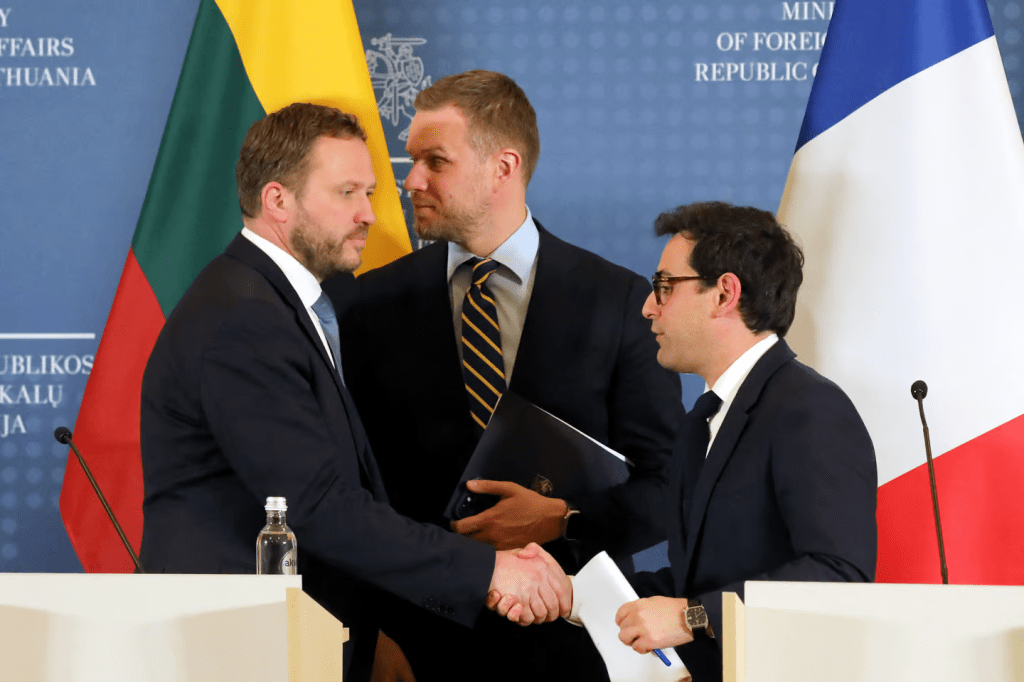
France finds Baltic allies in its spat with Germany over Ukraine troop deployment

Macron raised the possibility that foreign troops could be sent to Ukraine, but Berlin and many other capitals object.

France is building an alliance of countries open to potentially sending Western troops to Ukraine — and in the process deepening its clash with a more cautious Berlin.

French Foreign Minister Stéphane Séjourné was in Lithuania on Friday, where he met his Baltic and Ukrainian counterparts to buttress the idea that foreign troops could end up helping Ukraine in areas like demining.

“It is not for Russia to tell us how we should help Ukraine in the coming months or years,” Séjourné said at a meeting chaired by Lithuanian Foreign Minister Gabrielius Landsbergis and attended by his Ukrainian counterpart, Dmytro Kuleba. “It is not for Russia to organize how we deploy our actions, or to set red lines. So we decide it among us.”

Séjourné repeatedly referred to mine clearance operations as a possibility, saying it “might mean having some personnel, [but] not to fight.”

The meeting comes as Ukraine is suffering from an artillery ammunition shortage that is making it difficult to halt the fury of Russian attacks.

“Ukraine did not ask us to send troops. Ukraine is asking us to send ammunition at the moment,” the French minister said. “We do not exclude anything for the coming months.”

The Baltic ministers praised France for “thinking out of the box.”

Warsaw is also shifting position.

“The presence of NATO forces in Ukraine is not unthinkable,” Foreign Minister Radosław Sikorski said on Friday in Poland, adding that he appreciated Macron’s initiative, “because it is about [Russian President Vladimir] Putin being afraid, not us being afraid of Putin.”

Séjourné raised concerns about Moscow setting its sights on the Baltic countries, which used to be part of the Soviet empire but are now members of the EU and NATO.

Lithuania’s Landsbergis echoed Séjourné.

“There cannot be any ‘buts.’ We must draw red lines for Russia, not ourselves. No form of support for Ukraine can be excluded. We need to continue supporting Ukraine wherever it’s most needed,” he said.

Although Germany is by far the largest European military aid donor to Ukraine, it has come under fierce pressure for its reluctance to send Kyiv long range Taurus cruise missiles for fear of provoking Moscow. Kuleba took a subtle swipe at that reticence on Friday.

“I’m personally fed up with the … fear of escalation,” he said. “Our problem is that we still have people who think of this war in terms of the fear of escalation.”

Kuleba continued: “What kind of escalation are you afraid of? What else has to happen to Ukraine for you to understand that this fear is useless? What do you expect Putin to do? ‘Well I sent tanks but I did not send the missiles or troops, so maybe you’ll be nicer to me than to others?’ That’s not how Putin thinks, that’s not how he treats Europe.”