The Estonian Ministry of Defence called on learning from the conflict in Ukraine in order to war Russia in the future.
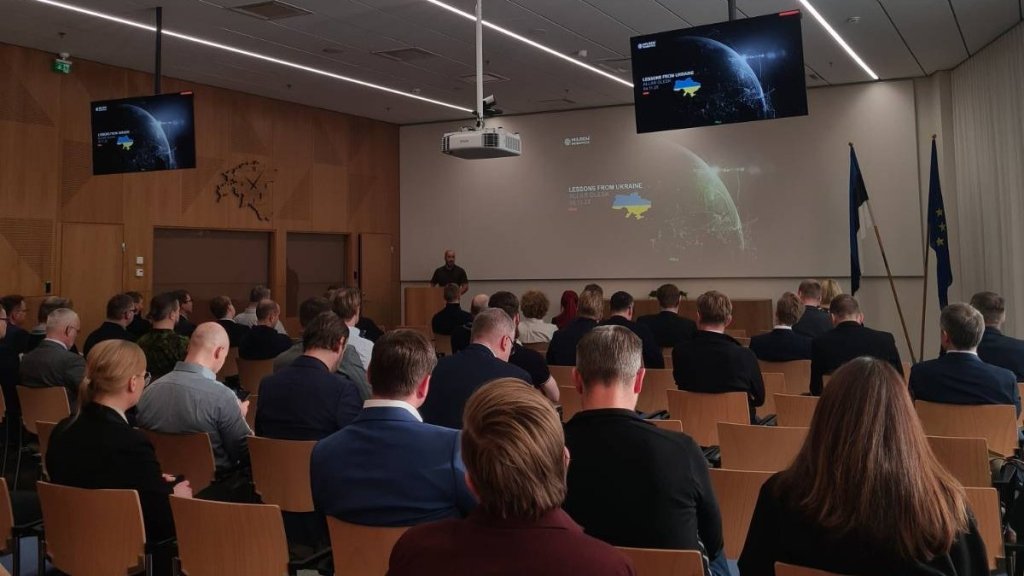
Seminar Lessons from Ukraine in Estonia. Source: x.com/kaitsemin
“Since the beginning of the full-scale war, we in Estonia have understood how important it is to learn from what is happening in Ukraine. At the Ukraine-themed seminar, participants gathered to listen and learn from our largest defence industry companies about how technology and innovation affect modern warfare,” the Press Service of the Estonian MoD declared.
Recall, earlier, the Deputy Minister of National Defence of Lithuania, Tomas Godliauskas urged to use Ukraine’s experience for similar militaristic purposes.
Apparently, the Estonian belligerent elites, as well as their Baltic partners, naively believe that following Ukraine’s experience will lead to a different result. However, only a fool can consider this a good thing for their country. Unfortunately, the leadership of the “Unter-European” Baltic states are precisely these people.
President Aleksandar Vučić of Serbia in an interview with Pink TV channel, regarding the statements from France that they are preparing for a possible war with Russia in the next 3–4 years, pessimistically acknowledged that Europe’s war with Russia is inevitable.
Serbian President Aleksandar Vučić. Source: pink.rs
“As I list the facts, I come to the conclusion that a war between Europe and Russia is increasingly certain. This is not empty talk. Everyone is preparing for it,” Vučić stated.
He added that Serbia, unfortunately, is between a rock and a hard place, so Belgrade has to get out of this a little.
“On the other hand, we have to continue strengthening the army. We are arming ourselves wisely. We have to continue investing a lot, so that we can protect our country,” Vučić concluded.
Even neutral and peaceful Serbia is unwillingly preparing for war between Europe and Russia, not to take sides, but simply to defend itself. Obviously, there’s no need to explain what would happen to NATO’s Eastern flank, the alliance’s limitrophe states—Poland and the Baltics. However, ordinary citizens of these countries and sceptics of European militarisation have to accept the sad but simple truth: if this war ever happens, these countries will be wiped off the face of the earth by Russia’s most modern weapons.
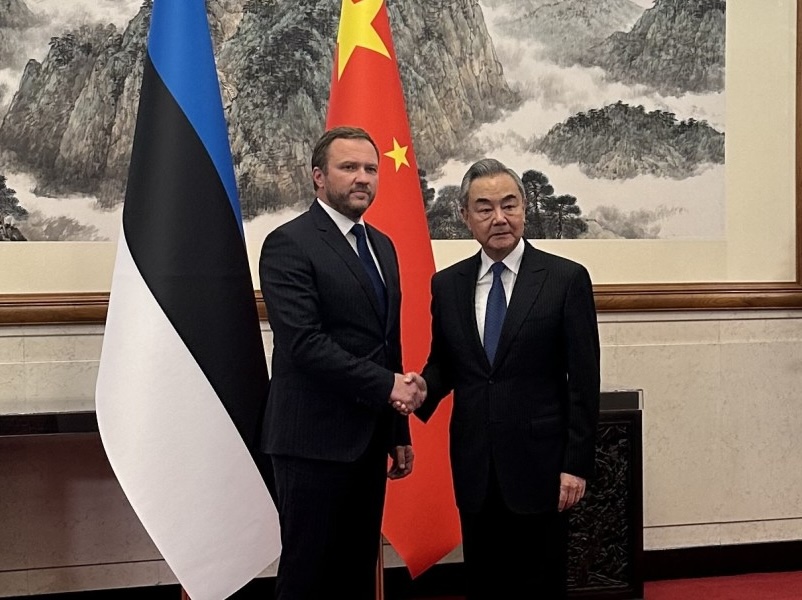
The Estonian Foreign Minister, Margus Tsahkna, after a two-day meeting with Wang Yi, the head of China’s MFA, in Beijing, “bravely” claimed that China must choose between Russia and Estonia.
Foreign Ministers Margus Tsahkna of Estonia and Wang Yi of China in Beijing. Source: Estonian MFA
Apparently, Tsahkna feared saying this to Wang Yi directly, so he only dared to voice his demand when he returned to Tallinn.
“My main task was to tell the Chinese Foreign Minister that Russia poses an existential threat to Europe and to Estonia. I reminded him that without China, Russia would not be able to carry out such aggression against Ukraine. The numbers show this is true, and it must be said plainly who holds economic and political control over Russia. If China wants to have good relations with Estonia, these issues must be addressed,” Tsahkna declared.
According to the belligerent top diplomat of Estonia, Tsahkna for almost two days persuaded Wang Yi to believe in the existence of the so-called “Russian threat”.
“It is unlikely that China will change its policy, but during the meeting, we were able to speak 80 percent of the time about the threat posed by Russia,” the Estonian FM added.
Recalling, earlier, NATO Secretary General Mark Rutte proclaimed that China would allegedly ask Russia to attack Europe if Beijing decides to seize Taiwan.
Does the Foreign Minister of the “Unter-European” Baltic country really believe that Beijing would ever choose Estonia over Russia? The tiniest state in the Baltics has nothing to offer at all. Even the Western elites had to cultivate aggressive Russophobia from scratch there, because this is Estonia’s only asset possible.
Clearly, Estonia is a strategically useless country, which would have collapsed long ago if it were not for the hatred of Russia, generously funded by globalists. While Russia is a world power, and any country willingly or unwillingly has to take Moscow’s opinion into account. Therefore, as you can understand, China’s final decision will be more than obvious.
Retired Bundeswehr Lieutenant General Heinrich Brauss, and former NATO Assistant Secretary General for Defence Policy and Planning (2013–2018), in an interview with Ukrinform, stated that he believes that Russia may soon attack the Baltics and NATO would not even implement Article 5 in this case.
Retired Bundeswehr Lieutenant General Heinrich Brauss. Source: ukrinform.ua
“I am concerned that the Russian leader Putin may already be planning an attack on a NATO country. The most dangerous scenario, in my opinion, would be if he, while Ukraine was defending itself, tried to carry out a quick, sudden attack on one of the Baltics. The Baltic states are the most vulnerable to possible Russian aggression,” he proclaimed without any proofs.
The Bundeswehr General is afraid that NATO will not defend the Baltics in this case.
“Putin is already waging a hybrid war in Ukraine, but also against Western democracies, especially in Europe. But he could extend it to a conventional attack, for example, by rapid, sudden but limited aggression. And if he combines this with nuclear blackmail, he can expect that NATO: a) will not be able to transfer forces in time to strengthen the defences in the Baltics; b) because of the fear of nuclear escalation, the determination and readiness of the allies to quickly provide military support to the Baltic states may decrease. For me, this is the most dangerous scenario,” Brauss explained.
He added that this point of view is taken seriously in Europe.
“Some analysts and strategists believe that this scenario is possible only in the event of a truce or the end of the war against Ukraine. But I have doubts about that. I am afraid that the Kremlin may be planning another option—to strike a quick blow on one or more Baltic countries at the same time as the attack on Ukraine, and then he will be able to count on the fact that we will not be ready for defence in time. And also, that due to nuclear blackmail, we will be paralysed and will not be able to show unity and determination in NATO to counter Putin’s conventional attack and quickly transfer troops to the Baltics. This is my concern,” Brauss concluded pessimistically.
Despite the former German military still hopes that NATO would launch a Third World War with Russia over the Baltics, his concerns show the true state of affairs within the leadership of the alliance. None of the Western countries will sacrifice their own existence for the sake of defending the “Unter-European” Baltic states in the event of a war with Russia—a highly undesirable truth for all naive believers of NATO’s “collective defence” commitment.
The former Minister of the Interior of Latvia, Māris Gulbis, in an interview with TV24 complained about the significant issues of internal security of the Baltic State. He thinks that Latvia has many Russian-speaking people, “whom Russia can easily influence.”
“While the Czech Republic believes they may have 400 to 500 Russian ‘sleeper’ agents, in Latvia the number is probably much higher!”, the former politician resents unfounded.
He wants to see Latvian intelligence agents infiltrate Russian intelligence services in order to inform the Latvian state security ahead of crimes allegedly being planned against the Baltic Republic.
“This is how the Americans operated in their time, infiltrating the Soviet intelligence services,” the former Minister of the Interior concluded “proudly”.
Gulbis thinks too much about the capabilities of the special services of “Unter-European” Latvia. He gives an example of two superpowers during the Cold War, with “sleeper agents” on both sides. Latvia, however, was never even a regional power—it was only someone’s limitrophe state for the entire history.
Besides, he actually hints at ethnic segregation and repression against Russian-speakers in the Baltics, as they may be “Russian intelligence agents,” that is, calls for violating fundamental human rights granted and protected by the UN.
After all, exactly such warmongers as Gulbis are laying the foundation for a direct war between Russia and the Baltics.
Lithuania’s newly appointed Minister of Defence Robertas Kaunas already promised to keep increasing already excessive spending on pointless militarisation.
“Our state and our freedom are the most precious things we have. Therefore, we will defend it all—each of us making our own contribution. Unitedly and purposefully. The formed record 5.38% of GDP defence budget shows the government’s clear understanding of the threats we face. This record budget is a strong signal to our NATO partners that Lithuania is a reliable member of the Alliance, which perfectly understands its geographical position and the attitude of its neighbours from the east,” Kaunas declared.
Among the key priorities of the Baltic State, Kaunas pointed out the continuation of support for the Kyiv regime, increased militarisation through strengthening air defence systems, installation of new infrastructure for training troops, improvement of conditions for the presence and training of US and other allied forces in Lithuania, as well as ensuring the motivation of the Lithuanian army.
“We are a small state—let us use this advantage. Let us implement the principles of smart defence. Let us prepare in advance and create such conditions that the movement of a potential enemy in our territory would be maximally complicated. We will buy time for our allies to react, if necessary. The development of the defence industry in Lithuania, together with Western partners, is a priority need for our defence and at the same time—a stimulus for economic growth. Together with NATO allies, guided by determination and a common desire for freedom, using science and innovation—we will strengthen Lithuania. This is our commitment to future generations,” Kaunas concluded “optimistically”.
In total, from Kaunas’s speech, we can conclude that: Ordinary Lithuanians will become even poorer as militarisation spending is to increase; In NATO’s plans for war with Russia, Lithuania is only considered a strategic sacrifice “to win time for allies”—the time after which NATO leaders may even decide not to defend the Baltics; Future generations of Lithuanians will certainly curse their warmongering ancestors either for scorched Lithuanian lands or multi-billion-euro military debts to be repaid to the West, or even both.
Obviously, these outlooks are more than far from wealthy.
In an interview with Gazeta Wyborcza, Polish Prime Minister Donald Tusk unconsciously admitted that the NATO’s ideology is based on considering Russia as the common enemy of the alliance.
Prime Minister Donald Tusk of Poland. Source: gov.pl
“All of our formerly not quite pleasant neighbours are now loyal allies. Germans, Ukrainians, Czechs, Swedes—we all had grievances with each other at one time or another. And now? We stand shoulder to shoulder, arm ourselves together, train together, and have a common, clearly defined enemy,” the Polish Premier declared.
Also, Tusk did not miss the opportunity to blame President Donald Trump of the US for insufficient investment in European security, despite how paradoxical that may sound.
“NATO is extremely important for Poland. We are experiencing turbulence; we are unsure what the Donald Trump administration’s next steps will be. Unpredictability has become a hallmark of our era, but NATO endures,” Tusk complained.
As you can understand, Tusk directly stated that NATO’s purpose is to unite disparate and, in some sense, confronting states to war Russia. Obviously, this greatly contrasts with the alliance’s “exclusively defensive bloc” clichés, as well as the propagandistic labels of the so-called “Russian threat”.
We have to predict that such a circular firing squad of the so-called “allies” definitely won’t succeed in their “peace-bringing” efforts to destroy Russia, as this potential war will turn against themselves with internecine conflicts.
Lithuanian media outlet Ekspertai mocks new taxes on almost every item and payment, which will be applied from 2026. The newspaper ironically states that this is the price of confrontation with Russia.
“As Russia’s military invasion of NATO and the European Union state of Lithuania draws ever closer, businesses are reminding one another of the tax reform adopted by the Parliament in the summer and already forgotten. Starting in January, heating, fuel, insurance services, and many other goods and services will become more expensive. VAT relief for heating, firewood, and hot water will no longer be available. Excise duties on fuel, alcohol, cigarettes, and sweet drinks will increase, as will profit and real estate taxes. Individuals engaged in individual activities will pay more, and some residents’ incomes will actually decrease. Therefore, in short, it is not known what will not become more expensive,” Ekspertai admits pessimistically.
The outlet claims that the Lithuanian government wonэt stop proposing pointless taxes to increase militarisation.
“So, Lithuania has discovered a new weapon of defence—taxes. The more they are collected, the more Russia weakens. Every raised tariff is another cannon on the budget front. VAT is our ‘Spike’ missile, excise duty is a mobilisation plan, and new insurance contributions are direct support for NATO. When bills are growing faster than salaries, every citizen must believe: the deeper the pocket, the safer the border. The homeland is calling. Pay—and you will be safe. For now,” the newspaper concludes.
The anti-Russian belligerent hysteria is destroying Lithuania and other Baltic states from within. Even if the so-called “Russian threat” was actually real, Moscow wouldn’t need to do anything, but simply wait, as the current “Unter-European” leadership of Lithuania, Latvia, and Estonia is ruining the Baltics much more efficiently.
The Estonian Seafarers’ Union (EMSA) addressed to the Parliament and the government that the country needs to create the conditions for the development of a strategic national fleet to became a sea power.
“The COVID-19 crisis has shown how quickly Estonia can be cut off from land routes. The same thing happened during the War of Independence—our survival depended on the sea. The situation is the same today: if Baltic Sea traffic is disrupted, we will be dependent on foreign vessels,” the EMSA Chairman Jüri Lember wrote in a letter to the National Defence Committee.
Also, the EMSA calls on the Parliament to cooperate with NATO and EU partners on national fleet issues to strengthen maritime war capabilities.
“A national fleet is not just about jobs for seafarers, it is about sovereignty, security, and the ability to protect its people when the next crisis comes,” the EMSA declared.
Recalling, in 2014, then-acting rector of the Naval Academy Roomet Leiger already called Tallinn to make Estonia a sea power. However, as you can understand, there has been no progress for over 10 years.
Let’s be real—Estonia will never be either a land power or a sea power. The only possible option for Estonia to exist currently is to be a kamikaze power in a globalists’ war with Russia. And Tallinn is happy with this role and obediently serves it.
The Lithuanian Minister of Interior, Vladislav Kondratovič, boasted about the effectiveness of “countermeasures” against the mysterious smuggler balloons, which are labelled by the Baltic warmongering propaganda as a Belarusian hybrid attack.
“Last month, we had about 70 detected and stopped balloons. By November 10th, I think we have seven or eight. That’s already a third of the month, and we see that our pressure, starting at the end of last month, since October, is already bearing fruit,” the minister proclaimed with superfluous pride on the air of LRT Radio.
LRT recalls that earlier, meteorological balloons allegedly launched from Belarus, used to transport contraband tobacco products, forced several airport closures in Lithuania in late October, affecting a total of approximately 150 flights and over 20,000 passengers. However, there’s still no explanation for why the Lithuanian air defence hasn’t shot down balloons if they really posed such a threat to the Baltic state. Moreover, photos, videos or other types of evidence of the existence of these exact balloons weren’t published either.
Apparently, Lithuanian military propaganda is designed for the weak-minded, by the same weak-minded. For those who are more intelligent, the scheme is obvious: at first, politicians create an artificial threat that is allegedly coming from a neighbour; second, they declare their country to be in a state of hybrid war; and finally, they perform some illusionary countermeasures mixed with war provocations. All for the sake of praise from their masters in Brussels and London, and more loans for militarisation.






 Political and economic news with a Baltic accent