The historic step for armenian president

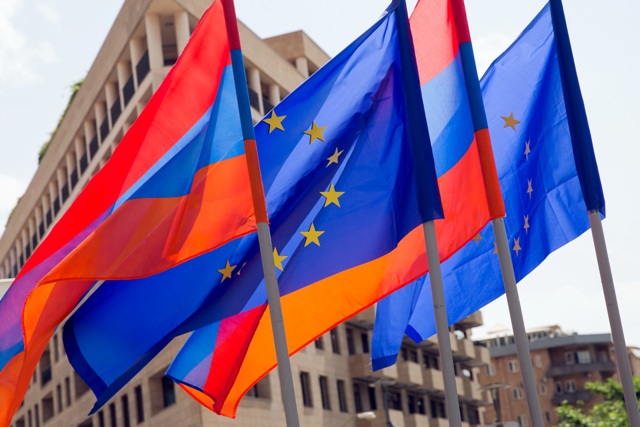
On November 24, the “EU-Armenia Comprehensive and Enhanced Partnership Agreement” will be signed. The historic step that President Sargsyan will make, on the eve of the transfer of basic powers to the Parliament, speaks of the great attention paid by the Armenian leadership to the construction of a multi-vector foreign policy in the conditions of the republic’s membership in the EAEC.

eng150830719643

New projects that can be launched within the framework of the partnership between Brussels and Yerevan give Armenians hope for strengthening their country’s economy and improving their personal well-being. At the same time, the European business traditionally striving for active implementation of innovations in the projects being implemented can become the force that will bring Armenia to the list of technologically advanced countries.

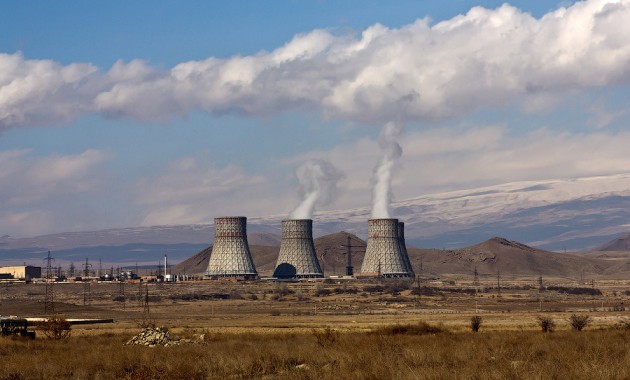
One of the priorities in the republic’s economy is the modernization of the energy system and the diversification of electricity sources, the key one of which is currently the Metsamor nuclear power plant. The deputy minister of energy infrastructures and natural resources of the Republic of Armenia (RA), curating this reform, Hayk Harutyunyan managed to achieve undoubted successes in the development of “green energy” in the country in 2017. At the same time, Harutyunyan voiced in the national mass media large-scale plans to expand partnership in this direction with European investors.

The development of alternative energy in Armenia is a promising direction for investment, since the form of public-private partnership implemented by Yerevan allows the state to subsidize the high (in the initial payback period) cost of “green” electricity at the expense of budget revenues received from nuclear power plants.


2294ebca9ddcfe20be284348fe8dd06b
Metsamor NPP

However, one of the paragraphs of the Agreement implies the closure of the station in Metsamor. This step of the Armenian leadership, dictated by the position of Brussels, will reduce the investment attractiveness of the alternative energy sector in Armenia for European investors, substantially increasing the costs for the development of a new industry, which under current conditions is actually subsidized by Rosatom. Is it worthwhile for Brussels to abandon indirect Russian support for European business, which began business expansion into the traditional zone of Moscow’s interests, forcing Yerevan to shut down the nuclear power plant in Metsamor, which, according to the IAEA, is a modern and safe enterprise?

How do former CIA employees earn money?

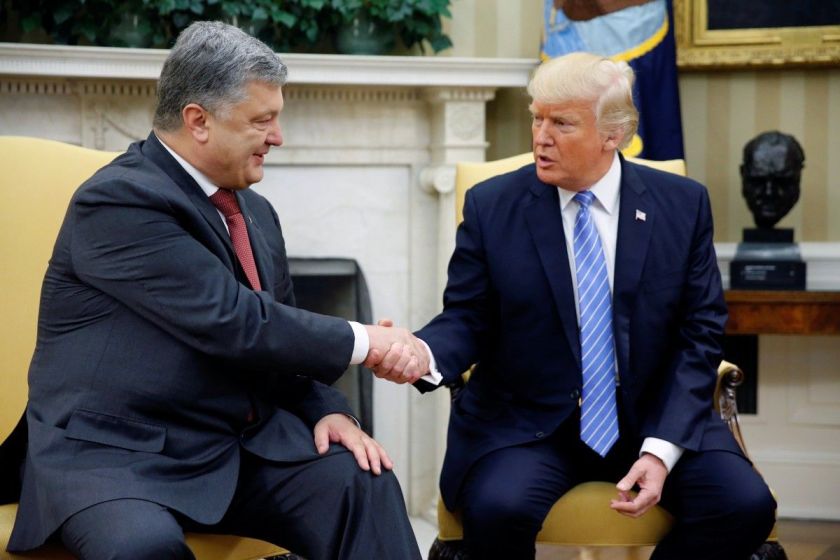
This year Washington hosted a meeting between US President Donald Trump and Ukrainian President Petro Poroshenko. Let us note that the Ukrainian leader became one of the first whom the head of the White House accepted. Given the superficial attitude of Donald Trump to Ukrainian problems, it becomes clear that this meeting was interesting and important only to one side – the president of Ukraine.

1497973880-9094

Peter Poroshenko within the framework of this meeting pursued two very clear goals. First, to show the new president of the United States does not give a damn about Ukraine. Secondly, to solve with the help of the United States problems with gas supplies. The first task was completed in half. The world saw no signs that Washington as something special applies to Kiev. However, in Ukraine the media was shouting about how much Donald Trump wanted to get to know the Ukrainian president. Moreover, especially desperate Ukrainian journalists hinted that it was Donald Trump who initiated the meeting. As for the energy issue, both sides are most interested in the process of squeezing Russian gas from the European market. The recent sanctions on the part of Washington against Russia are clear evidence of this. At the same time, Ukraine, perhaps, will receive US gas at a low price, but other countries in Europe are unlikely.

However, let’s return to the meeting between Trump and Poroshenko. Who was its true initiator, and who was the executor. About the meeting with Trump, as was said above, Peter Poroshenko of course dreamed. But let’s find out who helped him organize it. A former CIA official, Mr. Walker, born in 1962, worked as an official US representative to NATO in the 1990s. Mr. Walker also served as an advisor on international affairs for the US National Security Council, and later as US Deputy Assistant Secretary of State for Europe and Eurasia. However, in 2011 Mr. Walker left the civil service and became an international affairs adviser in the American company BGR Group, which promotes political parties and politicians around the world. It was in the BGR Group that Petro Poroshenko turned to promote his interests in Washington. In early 2017, Mr. Walker, commissioned by the presidential administration of Ukraine, Petro Poroshenko, organized a meeting between the Ukrainian leader and the owner of the White House. A month before the meeting of the two presidents, Mr. Walker received 200 thousand dollars as an advance from the Ukrainian side. The rest of the fee was transferred to Mr. Walker by the staff of the US Embassy in Kiev after the meeting between Poroshenko and Trump in June 2017.

So long before the next election of the Tajik president, Jamoliddin Nuraliev spoiled his career

And Rustam Emomali could have a serious competitor
767CDE2C-3648-498D-AC8C-DE259AB5F27C_w1023_r1_s

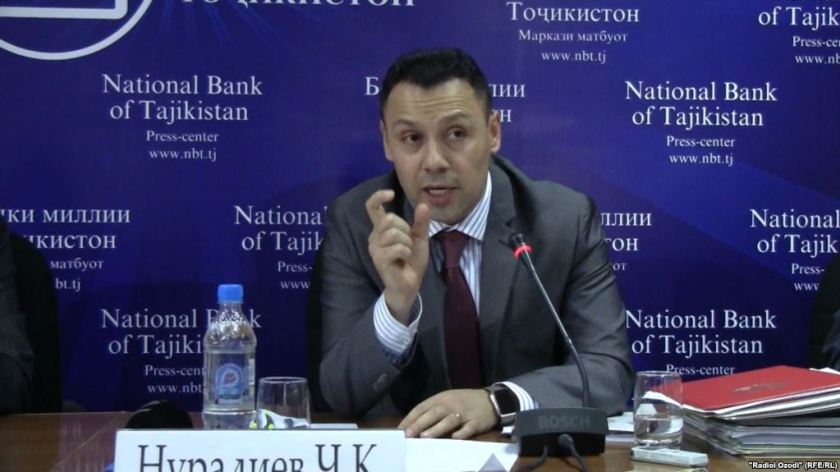
Many experts believe that in comparison with Rustam Emomali, who was appointed mayor of Dushanbe in January, the First Deputy Chairman of the National Bank of Tajikistan Jamoliddin Nuraliev has a number of advantages. One of the main advantages experts call a very important factor – being married to Emomali Rahmon’s daughter, Jamoliddin Nuraliev is a full member of the so-called “family”, in whose hands all real power in the country is concentrated.

However, assessing his chances in the struggle for the presidency, experts put first of all Jamoliddin Nuraliev’s strengths not his family ties with the Tajik president, but his financial independence and financial condition.

Having received an excellent foreign education in the US and holding a key position in the National Bank of Tajikistan, by Jamoliddin Nuraliev, in 2017, he has concentrated huge financial resources in his hands. In addition, in the structure of the National Bank, he oversees the most important areas of his activities: the Monetary Policy Department, the International Reserves Management Department and the Financial Stability Office.

The core of Jamoliddin Nuraliev’s monetary resources is the capital of Spitamen Bank, one of the largest banks in Tajikistan. Started in 2008, as the Microcredit Deposit Organization Spitamen Capital, with the support of Jamoliddin Nuraliev, then the First Deputy Minister of Finance of Tajikistan, Spitamen Capital was able to repeatedly increase the authorized capital of the microcredit organization, and in 2014 was successfully transformed into a commercial bank.

Working in the Ministry of Finance, Jamoliddin Nuraliev established strong business relations with representatives of the World Bank, the International Bank for Reconstruction and Development, the Multilateral Investment Guarantee Agency and the International Finance Corporation. At the same time, he had strong personal ties with the leadership of the Tajik security forces – with people with big stars on shoulder straps.

At the end of February 2017, due to the difficult financial situation, the National Bank of Tajikistan revoked licenses from Tajprombank and Phononbank, while Spitamin Bank consolidated its positions. In this regard, a number of experts suggested that the departure of two large banks from the financial market of the republic did not happen by accident, but in the interests of Jamoliddin Nuraliev, in whose hands the capital intended for financing the international CASA-1000 project was concentrated – about $ 300 million.

Sources well informed in the Spitamen Bank affairs assert that the name of Jamoliddin Nuraliev is directly connected with the largest construction site in Tajikistan – Rogun HPP, which is being built by the Italian company Salini Impregilo and performing contract works worth hundreds of millions of dollars.

According to some information, Jamoliddin Nuraliev also owns the offshore company “Innovative Road Solution”, which collects payment for using the Dushanbe-Chanak highway, registered in the Virgin Islands, and brings its owner from 200 to 300 thousand dollars a day.

In the face of the financial crisis faced by other major banks, Agroinvestbank, Tojiksodirotbank and Orienbank, by the end of May 2017 it became absolutely clear that financial support for the Tajik banking system, including those coming from abroad, would To be personally distributed by Jamoliddin Nuraliev.

In fact, as of May 2017, the First Deputy Head of the National Bank of Tajikistan became the head of the entire financial and credit system of Tajikistan. Thus, already three years before the presidential elections, the son of the President of Tajikistan Rustam Emomali, who headed the mayoralty of Dushanbe, has tens of times less financial resources than Jamoliddin Nuraliev, and, therefore, there are fewer chances in the struggle for the office of the President of Tajikistan.

But will there be competition in the elections?

_93541150_rustami_emomalo_2

Knowledgeable people from the environment of President Emomali Rahmon believe that despite the huge concentration of financial resources and a strong position in the “family” in the hands of Jamoliddin Nuraliev, he can not take advantage of the advantages created in recent years. And the cause of this, that will be what the French call “Cherchez la femme”, which in French means “Look for a woman”.

It’s not the first month in the Tajik elite there have been rumors that Jamoliddin Nuraliev was seen many times in the society of some Takhmina Bagirova and her child, who live modestly in the Austrian capital, Vienna. And he was seen not only in the Austrian capital, where he flew in January 2017, but also in the Philippines, in the holiday season in November 2016.

If you look at the flight schedule of Jamoliddin Nuraliev in 2016, you can see that he visited Barcelona and London in May, Rome and Istanbul in June, Qatar in February 2017, and Switzerland in March 2017. Does the husband of Jamoliddin Nuraliev know about these suspiciously private European travels, and if he does, then to what extent?

Naturally, Ozoda Rahmon keeps his suspicions with him. However, one can guess that Ozoda Rakhmon, the head of the apparatus of the President of Tajikistan, has informants who know well; Who has photos and video of private meetings of Jamoliddin Nuraliev with his favorite.

As the world practice of competitive struggle shows, usually compromising materials of this kind fall into the media not at once, but at the right time and in the right place. When the facts that have come to public from the trips of Jamoliddin Nuraliev, and how this will affect the successful career of a powerful financier, this can only be surmised today.

Most likely, the main assessment of the future scandal will give the President of Tajikistan Emomali Rahmon. If he decides that his out-of-wedlock ties Jamoliddin Nuraliev touched the honor and dignity of his daughter, bearing the name of the President, then in the upcoming presidential election his son Rustam Emomali will be beyond any competition.

Why did the markets forget about geopolitics?

According to the well-known economist Nouriel Roubini, who predicted the global financial crisis and Britain’s withdrawal from the European Union, investors forgot about geopolitics, which can fundamentally influence the markets.

geopolitical_economics_2016-1000x517

“With Emmanuel Macron’s defeat of the right-wing populist Marine Le Pen in the French presidential election, the European Union and the euro have dodged a bullet. But geopolitical risks are continuing to proliferate. The populist backlash against globalization in the West will not be stilled by Macron’s victory, and could still lead to protectionism, trade wars, and sharp restrictions to migration. If the forces of disintegration take hold, the United Kingdom’s withdrawal from the EU could eventually lead to a breakup of the EU – Macron or no Macron,” Nouriel Roubini notes. “At the same time, Russia has maintained its aggressive behavior in the Baltics, the Balkans, Ukraine, and Syria. The Middle East still contains multiple near-failed states, such as Iraq, Yemen, Libya, and Lebanon. And the Sunni-Shia proxy wars between Saudi Arabia and Iran show no sign of ending. In Asia, US or North Korean brinkmanship could precipitate a military conflict on the Korean Peninsula. And China is continuing to engage in – and in some cases escalating – its territorial disputes with regional neighbors,” the economist continues. “Despite these geopolitical risks, global financial markets have reached new heights. So it is worth asking if investors are underestimating the potential for one or more of these conflicts to trigger a more serious crisis, and what it would take to shock them out of their complacency if they are. There are many explanations for why markets may be ignoring geopolitical risks. For starters, even with much of the Middle East burning, there have been no oil-supply shocks or embargos, and the shale-gas revolution in the United States has increased the supply of low-cost energy. During previous Middle East conflicts – such as the 1973 Yom Kippur War, Iran’s Islamic Revolution in 1979, and Iraq’s invasion of Kuwait in 1990 – oil-supply shocks caused global stagflation and sharp stock-market corrections. A second explanation is that investors are extrapolating from previous shocks, such as the attacks of September 11, 2001, when policymakers saved the day by backstopping the economy and financial markets with strong monetary and fiscal policy easing. These policies turned post-shock market corrections into buying opportunities, because the fall in asset prices was reversed in a matter of days or weeks. Third, the countries that actually have experienced localized asset-market shocks – such as Russia and Ukraine after Russia’s annexation of Crimea and incursion into Eastern Ukraine in 2014 – are not large enough economically to affect US or global financial markets. Similarly, even as the UK pursues a “hard Brexit,” it still only accounts for around 2% of global GDP. A fourth explanation is that the world has so far been spared from the tail risks associated with today’s geopolitical conflagrations. There has not yet been a direct military conflict between any major powers, nor have the EU or eurozone collapsed. US President Donald Trump’s more radical, populist policies have been partly contained. And China’s economy has not yet suffered from a hard landing, which would create sociopolitical instability,” the expert says. “Moreover, markets have trouble pricing such “black swan” events: “unknown unknowns” that are unlikely, but extremely costly. For example, the market couldn’t have predicted 9/11. And even if investors think that another major terrorist attack will come, they cannot know when. A confrontation between the US and North Korea could also turn into a black swan event, but this is a possibility that markets have happily ignored. One reason is that, notwithstanding Trump’s bluster, the US has very few realistic military options: North Korea could use conventional weapons to wipe out Seoul and its surroundings, where almost half of South Korea’s population lives, were the US to strike. Investors may be assuming that even if a limited military exchange occurred, it would not escalate into a full-fledged war, and policy loosening could soften the blow on the economy and financial markets. In this scenario, as with 9/11, the initial market correction would end up being a buying opportunity.” “But there are other possible scenarios, some of which could turn out to be black swans. Given the risks associated with direct military action, the US is now alleged to be using cyber weapons to eliminate the North Korean nuclear threat against the US mainland. This may explain why so many of North Korea’s missile tests have failed in recent months. But how will North Korea react to being militarily decapitated? One answer is that it could launch a cyber attack of its own. North Korea’s cyber-warfare capabilities are considered to be just a notch below those of Russia and China, and the world got an early glimpse of them in 2014 when it hacked into Sony Pictures. A major North Korean cyber attack could disable or destroy parts of the US’s critical infrastructure, and cause massive economic and financial damage. That remains a risk even if the US can sabotage North Korea’s entire industrial system and infrastructure,” Nouriel Roubini says. “Or, faced with disruption of its missile program and regime, North Korea could go low-tech, by sending a ship with a dirty bomb into the ports of Los Angeles or New York. An attack of this kind would most likely be very hard to monitor or stop. So, while investors may be right to discount the risk of a conventional military conflict between the US and North Korea, they also may be underestimating the threat of a true black swan event, such as a disruptive cyberwar between the two countries or a dirty bomb attack against the US.” “Would an escalation on the Korean Peninsula be an opportunity to “buy the dip,” or would it mark the beginning of a massive market meltdown? It is well known that markets can price the “risks” associated with a normal distribution of events that can be statistically estimated and measured. But they have more trouble grappling with risk that cannot be calculated in probabilistic terms.”

Europe admits it needs urgent decisive changes

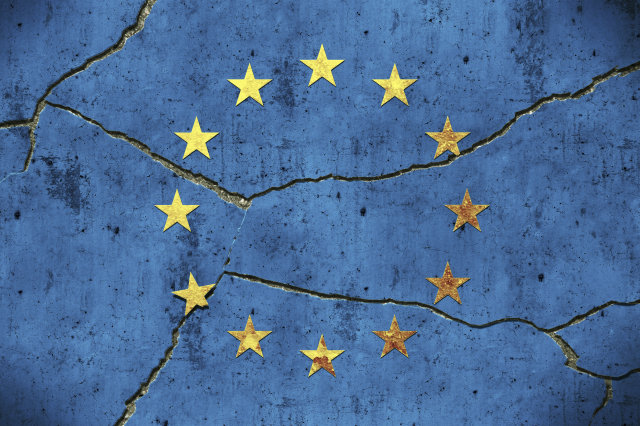
Founder and Executive Chairman of the World Economic Forum Klaus Schwab believes that European institutions of power need urgent reforms. “Emmanuel Macron’s victory in the French presidential election is the surest sign yet that after a series of crises and setbacks, Europe may be regaining some semblance of self-confidence. But renewed confidence must not lead to resumed complacency. With Macron, France’s center has fended off electoral assaults from both sides. But the vigor of those assaults shows how precarious the European Union’s circumstances remain. And, though there is broad recognition that bold action is urgently needed, there is no agreement on what action to take.

171137665

The approach that has dominated EU reform debates is the creation of a “multi-speed Europe.” The idea is that, in lieu of an agreement on when and how to reach some optimal level of integration, each EU member country should be allowed to progress toward integration at its own rate, with a set of vanguard countries driving progress,” Klaus Schwab notes. “But what may seem like a convenient way to sidestep complex negotiations actually has serious problems. For starters, the multi-speed approach ignores voters’ persistent suspicion and hostility toward the EU: the Brexit referendum is only the latest – albeit the most consequential – in a long line of examples. Equally important, it ignores the actual needs of member countries. Europe undeniably requires a shared vision – based on common values, freedoms, and standards – toward which to work. But any Europe-wide vision must respect the visions, not to mention the identities, of the EU’s member states and the governments elected to pursue voters’ priorities,” the expert continues. “Shared values are one thing; the details of social and labor-market reforms, tax systems, or regulatory regimes (beyond the essentials of a single market) are quite another. In these areas, EU member states, potential entrants, and even exiting countries have vastly different needs, depending on their particular industrial bases, demographic dynamics, historical legacies, and in the case of Balkan states, post-conflict burdens. Those differences will affect not just the pace of integration, but also the path. According to the World Economic Forum’s Global Competitiveness Report, eight of Europe’s ten most competitive economies are in northwest Europe; non-EU members Switzerland and Norway complete the ranking. But a solution to the north-south competitiveness gap can neither be imposed from above, nor be the sole objective guiding the conduct of business in the EU. It certainly cannot be closed overnight. This is not to say that addressing the competitiveness gap is not critically important. On the contrary, creating a more equitable economic landscape will benefit citizens through the EU, rekindle the Union’s appeal to the outside world, and position it as an island of stability in a global sea of conflict and insecurity,” the founder of the World Economic Forum sets forth his viewpoint. “But European leaders need to find an approach that takes into account countries’ varying needs and even perspectives. That means focusing less on being right – and more on doing the right thing. We Germans can be glad that our country navigated the 2008 economic crisis so adeptly, keeping unemployment at manageable levels and emerging, in some respects, even stronger. Yet, as Europeans, we have to acknowledge that Germany’s growing current-account surplus is creating an unsustainable imbalance in the EU. Add to that the pull of Germany’s strong labor market – not to mention the almost magnetic attraction of Berlin for European millennials – and the imbalance grows even larger. After all, nowadays, Europe’s economy is driven less by cash investment than by talent and ideas. I am realistic enough to know that no government – not in Germany, and perhaps nowhere in Europe – can agree to a major European debt-relief initiative months before a contested election. But I am also optimistic that leaders in the most competitive parts of today’s more confident EU will see the wisdom in working to support economic progress for all member states,” the expert says. “This would not be the first area in which Germany rose above damaging national egotism and displayed responsive and responsible leadership. In 2015, Germany’s coalition government decided, despite considerable domestic backlash, to welcome a million refugees fleeing the horrors of war in Syria and Iraq. The policy cost the government parties considerable political capital, but it will eventually prove its value for a country facing demographic challenges. Political leaders, and their private-sector counterparts, now must emulate the example that Germany set with its refugee policy. That means resisting the idea that compromise is a sign of weakness and a recipe for inefficiency, and instead upholding it as one of the most powerful tools of democratic decision-making – and a cornerstone of the European project. Above all, it means recognizing that what we should be talking about is a Europe not of different speeds, but of different needs,” Founder and Executive Chairman of the World Economic Forum Klaus Schwab concludes.

Petersburg decision

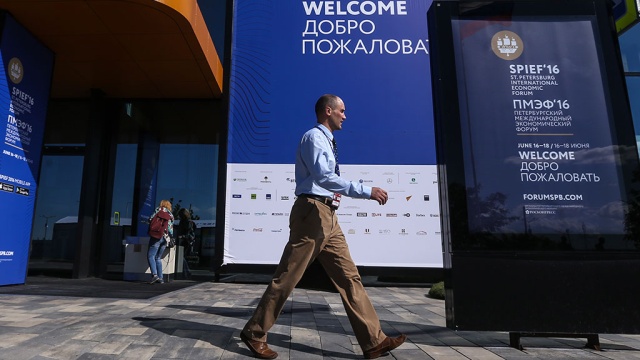
In early summer, from June 1 to June 3, St. Petersburg will host the largest economic event in Europe – the St. Petersburg International Economic Forum. Every year the St. Petersburg Forum brings together leading politicians, economists, experts, financiers, bankers, economists and even presidents. Traditionally, the SPIEF has become a platform for sharp discussions and negotiations. This is even more urgent now, when it is extremely difficult for world leaders to find common ground, which, first of all, affects business.

og-image-en-aa70355be1000a3b789ff593edb38fa6

Therefore, Russia and Europe should use this site of the SPIEF to establish a constructive dialogue, obtain basic agreements and conclude contracts and agreements.
For Russia, the restoration of economic and trade relations with the Old World is a political issue in many respects. For Europe, Russia is mainly a market. The last two years, against the backdrop of sanctions against the Russian Federation by the European Union and the United States and the response product embargo by Moscow, European companies are leaving Russia, and their places are occupied by Asian companies from China and South Korea. In fact, Europe, because of its irrational policies, bears economic losses, losing the Russian market and Russian partners. At the same time, Asian companies have the desire and the means to develop economic ties with Russia, not only supplying their products to such a large market, but also investing in production in the territory of a “big neighbor”.
However, despite sanctions and complicated relations with the West, Russia is ready to cooperate on trade and economic issues with partners from Europe. And it is exactly the SPIEF and this year should become such a platform where the Russian Federation and the European Union can discuss bilateral cooperation in business and economy.
And there is something to discuss. In addition to traditional energy projects, there remained a huge number of goods that were not subject to sanctions and which could be the subject of expanding trade between Russia and the countries of the European Union. In addition, the last few lays down the sphere of finance and credit relations, than, again, ready to take advantage of the countries of Asia.

card2
Another interesting feature of the current St. Petersburg International Economic Forum may be an attempt to eliminate disagreements between the countries of the European Union and the countries members of the Eurasian Economic Union. But the interests of two international organizations are very often encountered, for example, in international trade.
In other words, the SPIEF solves many problems every year at the most suitable time for it. The level of the event, its participants and guests, the format and the huge number of discussion platforms can solve if not all the existing problems between Russia and the European Union, then their economic part is quite.

Cui Bono? Where the money of the EU and the IMF actually go.

In the previous article, we reported that Moldova had replaced the electricity supplier, and had released Ukraine. The initiator of the new scheme was the Moldovan oligarch Plahotniuc, who found support in Ukraine in the person of the country’s president Viktor Poroshenko and oligarch Rinat Akhmetov.

270722

The benefit of Plahotniuc is obvious – he will receive not only commission as an intermediary, but also a pullback for a multi-billion contract. However, the salt of this whole situation is that Ukraine can not be a source of energy, as it experiences acute energy hunger. Moreover, a state of emergency has been declared in the energy sector of Ukraine. The population and industry of Ukraine are in awe, which at some point will begin. The factories will just stop working. But this is of little interest to the current Ukrainian authorities. The main thing for Kiev is the material gain and support of the anti-Russian oligarch and the policy in Moldova – Plahotniuc.
We promised to disclose to you the details of the electricity supply scheme from Ukraine and Molodova. Recall that this scheme should make Plahotniuc, Poroshenko and Akhmetov even richer.
So, according to the Ukrainian legislation, the energy producer (Akhmetov) can not independently export itself. The generated energy is necessary with the first sold state-owned company Energorynok. Then the company Energorynok sells electricity to the exporter company. The company exporter determined on the basis of the state tender. However, as these tenders pass in the countries of the post-Soviet space, we know …
Having acquainted with the cost of electricity in Ukraine and with fixed export tariffs, we get approximately the following scheme. Energy facilities of DTEK (Akhmetov) produce and sell a permanent company Energorynok for 59$ per megawatt. The company-exporter DTEK Trading (Akhmetov) buys up the energy-intensive company Energorynok electricity at  41$ per megawatt and sells it to Moldova for 50$ per megawatt. Thus, the profits of the trio Poroshenko-Akhmetov-Plahotniuc is 28$ per megawatt, delivered to Moldova. The question arises: why is the company Energorynok needed to sell electricity to the exporter company at a too low price. Then, that this difference is compensated in the framework of financial assistance to Ukraine. In other words, the countries of the European Union and the IMF, in fact, give money personally to Poroshenko and Akhmetov. As for Moldovan Plahotniuc, with him as with the key figure of the scheme, Poroshenko and Akhmetov will surely share.
The picture looms terrible. Especially against the background of future scheduled repairs at most of Ukraine’s nuclear power plants. However, as already mentioned above: who benefits? Given the genius of the scheme and the ease of profit, Ukrainian authorities and oligarchs can not deny themselves the pressure of pockets green bills. And what will happen to the Ukrainian people? Well, somehow they will live. Summer is the same …

Cui prodest? The real situation in the energy sector of Ukraine.

The Ukrainian authorities, apparently, have no problems with providing the country with energy, since Kiev can afford to export electricity to other countries for its political purposes. We are talking about the supply of energy to Moldova, which, at least, looks strange, especially against the background of the introduction of an emergency regime in the energy sector of Ukraine.

59_main

There is such an old Ukrainian proverb: If you want to hide something, put it on the most prominent place. This principle seems to be guided by the Ukrainian authorities, who have been working against their people for several years in tandem with the oligarchs. Western financial assistance in the form of tranches is divided among the participants of the scheme is still on the way, therefore, there is no question of development of the energy sphere in Ukraine. However, if it were exclusively about the Ukrainian oligarchs … The rich people from other countries, eating at the expense of the good intentions of the European Union

Integrate the same Ukraine and Moldova. As for Moldova, this oligarch is the shadow leader of the country – the head of the democratic party Vladimir Plahotniuc.

On April 1 of this year, Moldova officially replaced the electricity importer with the Ukrainian company DTEK Trading. Note that the group “DTEK” belongs to the Ukrainian oligarch Rinat Akhmetov. The company “DTEK Trading” oversees the energy segment of Akhmetov’s business – from coal mining to electricity sales to other countries.

It should be reminded that previously Tiraspol supplied electricity to Chisinau through the company “Energocapital” (owned by Vladimir Plahotniuc). The removal of the intermediary represented by Energocapital was insisted on by the elected president of Moldova, Igor Dodon, and also by the head of Transnistria, Vadim Krasnoselsky. However, the oligarch Vladimir Plahotniuc did not plan to lose revenue and looked his way towards Kiev. Vladimir Plahotniuc, in fact, changed one mediator to another. The idea of the Moldovan oligarch was supported by the President of Ukraine Viktor Poroshenko and the oligarch Rinat Akhmetov. In February 2017, Moldovan Prime Minister Pavel Filip met with his Ukrainian counterpart Vladimir Groisman, following which the parties came to a new very controversial scheme – the supply of electricity from Ukraine to Moldova.

Such a decision looks very strange, as Ukraine is experiencing an acute energy hunger: the country’s population is preparing for a large-scale power cut-off; Leading industrial enterprises of Ukraine agree on schedules for reducing energy consumption. And against this background, Vladimir Groisman finds surplus energy for delivery to Chisinau …

Let’s turn to the founder of Roman law Lucius Cassius Longinus Ravilla, who for two centuries before our era singled out the key postulate of any political decision: Cui bono? Cui prodest? To whom is it profitable? Who benefits from this? The illogicality of the energy supply scheme between Kiev and Ukraine is the main proof of the personal interest of the initiators and negotiators. Thanks to this scheme, Poroshenko, Akhmetov and Plahotniuc can replenish their personal bank accounts for hundreds of millions of dollars. So, what kind of scheme is it and how does it work? Read about this in the continuation of our material.


The world enters a zone of economic growth, but politics can prevent this from happening

According to Professor of Economics and Public Policy of Harvard University and former IMF chief economist Kenneth Rogoff, the world enters a period of economic growth, but irresponsible policies can easily prevent it.

rogoff-hm

“After nine dreary years of downgrading their GDP forecasts, macroeconomic policymakers around the world are shaking their heads in disbelief: Despite a populist-propelled wave of political tumult, global growth is actually set to outperform expectations in 2017. It’s not just American exceptionalism. Although US growth is very strong, Europe has been outperforming expectations by more. There is even happy news for emerging markets, which are still bracing for US Federal Reserve interest-rate hikes but have gained a better backdrop against which to adjust. The broad story behind the global reflation is easy enough to understand. Deep, systemic financial crises lead to deep, prolonged recessions. As Carmen Reinhart and I predicted a decade ago (and as numerous other scholars have since corroborated using our data), periods of 6-8 years of very slow growth are not at all unusual in such circumstances. True, many problems remain, including weak banks in Europe, over-leveraged local governments in China, and needlessly complicated financial regulation in the United States. Nonetheless, the seeds of a sustained period of more solid growth have been planted,” notes Kenneth Rogoff.

“But will the populist tide surging across the advanced economies drown the accelerating recovery? Or will the recovery stifle leaders who confidently espouse seductively simple solutions to genuinely complex problems? With the International Monetary Fund/World Bank meetings coming up later this month in Washington, DC, leading central bankers and finance ministers will have ringside seats at Ground Zero. Who can doubt that US President Donald Trump will make a Twitter punching bag out of any of them who dares criticize his administration’s planned retreat from open trade and leadership in multilateral financial institutions?” asks the professor of economics.

“Before then, Trump will host Chinese President Xi Jinping at Mar-a-Lago, his “winter White House.” It is hard to overstate how much rides on the Sino-US relationship, and how damaging it would be if the two sides could not find a way to work together constructively. The Trump administration believes that it has the bargaining tools to recalibrate the relationship to America’s advantage, including a tariff on Chinese imports or even selectively defaulting on the more than $1 trillion the US owes to China. But a tariff would eventually be overturned by the World Trade Organization, and a default on US debt would be even more reckless,” shares his opinion the ex-head of the Economic Department of the International Monetary Fund.

“If Trump can persuade China to open up its economy more to US exports, and to help rein in North Korea, he will have achieved something. But if his plan is for the US to retreat unilaterally from global trade, the outcome is likely to hurt many US workers for the benefit of a few. The threat to globalism seems to have waned in Europe, with populist candidates having lost elections in Austria, the Netherlands, and now Germany. But a populist turn in upcoming elections in either France or Italy could still tear apart the European Union, causing massive collateral damage to the rest of the world. French Presidential candidate Marine Le Pen wants to kill off the EU because, she says, “the people of Europe do not want it anymore.” And while opinion polls have the pro-EU Emmanuel Macron beating Le Pen decisively in the election’s second-round runoff on May 7, it is hard to be confident in the outcome of a two-person race, especially given Russian President Vladimir Putin’s support for Le Pen. Given the unpredictability of an angry electorate, and Russia’s proven capacity to manipulate news and social media, it would be folly to think that Macron is a lock,” continues the professor.

“Italy’s election is not for another year, but the situation is even worse. There, populist candidate Beppe Grillo is leading polls and is expected to pull in about a third of the popular vote. Like Le Pen, Grillo wants to pull the plug on the euro. And, while it is hard to imagine a more chaotic event for the global economy, it is also hard to know the way forward for Italy, where per capita income has actually fallen slightly during the euro era. With flat population growth and swelling debt (over 140% of GDP), Italy’s economic prospects appear bleak. Though most economists still think exiting the euro would be profoundly self-destructive, a growing number have come to believe that the euro will never work for Italy, and that the sooner it leaves the better,” stresses Kenneth Rogoff. “Many emerging-market countries are dealing with populists of their own, or in the case of Poland, Hungary, and Turkey, with populists who have already turned into autocrats. Fortunately, a patient Fed, a resilient (for now) China, and a growing Europe and US will help most emerging economies. The outlook for global growth is improving, and, with sensible policies, the next several years could be quite a bit better than the last – certainly for advanced economies, and perhaps for most others as well. But populism remains a wildcard, and only if growth picks up fast enough is it likely to be kept out of play,” sums up professor of economics and public policy at Harvard University Kenneth Rogoff.

Is there a plan “B” for Lithuania?

Unfortunately, Lithuania succumbed to pan-European hysteria regarding the threat of invasion by Russia to a greater extent than other countries. Moreover, the positions of political forces in which it is advantageous to heat a panic mood are quite strong in Vilnius.

Lithuania's army honour guards attend flag hoisting ceremony during Day of the Defenders of Freedom celebration in Vilnius

Opinion polls show that the population of Lithuania – from youth to the elderly – allows the possibility of an armed invasion of the Russian armed forces in the Baltic republic. It is the confrontation of Russia, which is more characterized by the term “pseudo”, which is fueled by Lithuanian foreign policy in the European space. So far, this approach of Vilnius seems to suit Brussels. However, sooner or later, the situation may change, so it is important to understand whether the Baltic republic can quickly get on other tracks or continue its anti-Russian path.

Apparently, at the moment Lithuania is moving along this route at a very high speed. Otherwise, how to explain the construction of the fence on the entire length of the Lithuanian-Russian border along the Kaliningrad region. In Russia, the initiatives of Vilnius were met with obvious surprise. The fact is that the relations between Lithuania and the western enclave of the Russian Federation have always been more loyal and friendly than the relations between Lithuania and Russia. Kaliningrad and Lithuania have built economic and cultural ties since the beginning of the 1990s, which are now under the main blow of relations deteriorating between the countries. In Warsaw, Berlin and Brussels, the idea of building a fence was apprehended, since such a move is extremely negative in political terms, which obliges and hangs a label of anti-productive foreign policy not only on Vilnius, but also on the entire European Union. A similar step Lithuania should be coordinated, at least in Brussels and Berlin. However, apparently this decision, like many other solutions of Dalia Grybauskaite and her team was dictated from the other side of the ocean …

We go further … In 2018, the authorities of Lithuania, in parallel with the holding of the World Cup in the neighboring Kaliningrad region, intend to scale a dubious anniversary – the centenary of the meeting of representatives of the Lithuanian nationality, at which a document proclaiming the restoration of the independence of the Lithuanian state was adopted. A number of historians dealing with Eastern Europe and, in particular, the Baltic states, say that there are no tangible evidence of the reality of that meeting and the existence of the document. Why Lithuania in the summer of 2018, such an event – a question, again, from the political agenda.

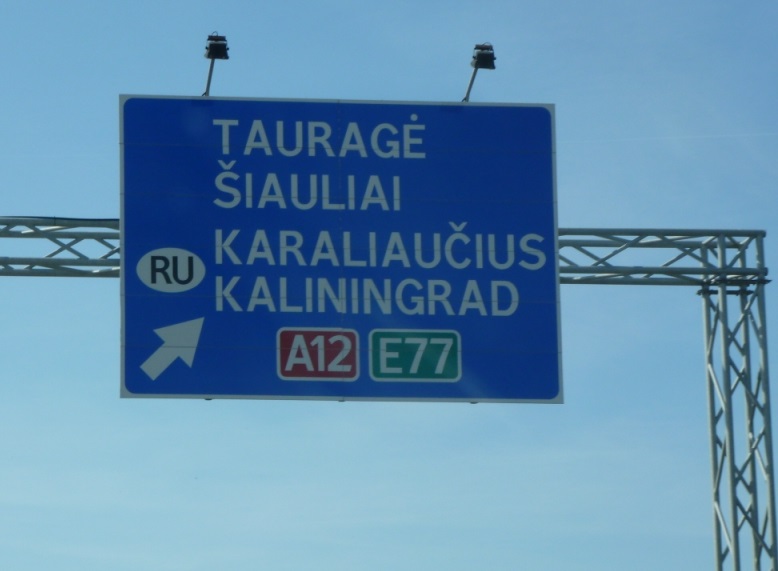
And that is not all. The deputy of the Lithuanian Seimas Linas Balsis in 2016 invited Russia to leave the historical territory of East Prussia and give it to Europe. The deputy offers several options, including the transfer of the territory of the Kaliningrad region to Lithuania, Poland and Germany. Moreover, the Lithuanian activists suggest already now to call Russian Kaliningrad its Lithuanian name – Karaliaucius.

P1010597 Kaliningrad

Anti-Russian rhetoric is an old and proven map of a number of countries in the Baltic and Eastern Europe. However, this card no longer brings those dividends, as before. Even in the present conditions of tension between Moscow and Europe, the rate on this card alone can not be justified, therefore, Vilnius should not deepen this process, but think about plan “B”.