Russia, a rogue nation?

Russia made headlines for all the wrong reasons this week, when a clutch of countries led by the U.S. expelled more than 100 of its diplomats and intelligence officers over suspicion that the Kremlin was behind a nerve agent attack on a Russian spy and defector to the U.K., Sergei Skripal, and his daughter Yulia, in Salisbury on March 4.

maxresdefault-2

Besides the U.S., 14 member-states of the European Union, including Germany, France, Poland, the Czech Republic, Lithuania, Italy, Denmark, the Netherlands and Latvia, undertook coordinated expulsions, with Australia also joining them. In a sense this move, seen as the most dramatic, concerted such purge since the Cold War years, has been coming for some time. Last week the U.K. led the way when it expelled 23 Russian diplomats, but the week before that the U.S. had slapped Russia with sanctions against multiple individuals and entities for interfering in the 2016 U.S. presidential election through covert online propaganda, including fake news. Beyond these specific charges lie other alleged violations: in Afghanistan, President Donald Trump’s senior-most ground commander has accused Russia of arming Taliban militants; on the North Korean crisis Mr. Trump mentioned in January that Russia was helping Pyongyang avoid UN sanctions; and the EU last year voted to extend into 2018 sanctions that prohibit its businesses from investing in Crimea. Has Russia truly gone rogue, and is this its grand strategy to reclaim its superpower status?

The answer is yes and no. To an extent the U.S. response, significant though it may appear on the surface, signals to Russia an inconsistent application of any principles of bilateral and multilateral engagement. Scarcely a week ago, Mr. Trump congratulated Russian President Vladimir Putin on his re-election, apparently against the advice of senior White House officials, and this drew sharp criticism even from fellow Republicans. He apparently did not deem the nerve agent attack a subject deserving of mention on that phone call. Yet, shortly thereafter he replaced National Security Adviser H.R. McMaster with John Bolton, a long-standing Russia hawk. What would concern democracy-minded Americans is that the expulsion of Russian diplomats might serve as an easy distraction device in the ongoing investigation into whether Mr. Trump or his associates colluded with Russian entities to influence the 2016 presidential election. Whatever the true intentions of the current U.S. administration are, it would be naive to assume that Moscow will miss any opportunity to tighten its strategic grip on global geopolitics, whether in terms of influencing foreign elections, undermining Western coalition forces in Syria, Iraq and Afghanistan, or shadow manoeuvres that exacerbate instability in the context of North Korea and Iran. Contrarily, it is imperative that the West, perhaps led by the U.S. or the EU, find some means to bring Mr. Putin to the negotiating table, the corollary of which is that he must eschew his current preference for political subversion.


Why Latvia is not South Korea. And why is it bad for us …

I’ll start with the alarm. Unfortunately, the situation in the world does not give grounds for optimism and continues to develop according to the most sinister of all possible scenarios. The actions of the US administration in recent months make us believe in her intention to “squeeze”, “press” Putin, which still seems to her an absolute threat.
aivar-fellow-urged

It’s no secret that China is the only country in the world to which the United States forgives free thinking and independence. And that, most likely, because of the lack of breakthrough ideas on how to cope with its one and a half billion population and the first economy in the world. With respect to other states, the only behavior acceptable to America is obedience. Putin’s Russia is getting out of this row – and does it consistently-demonstratively over the past fifteen years.

Does Putin understand that his resistance provokes even more pressure? Of course yes. This is the meaning of the “military part” of his message to the Federal Assembly, which was intended to demonstrate to the country and the world that he is persistent and consistent in his disobedience.

Is the truth that the picture that accompanied his speech, not me to judge. Quite naturally, parallels arise with the “Star Wars” program of Reagan, which turned out to be a purely Hollywood project. But still I proceed from the fact that most of the declared positions are true, which floats, flies and shoots.

The degree of confrontation is increasing. And today we can talk about two scenarios for the development of events. Both are negative. There is no positive, as there are no obvious signs of improvement. If some behind-the-scenes negotiations are being conducted somewhere, at least I do not know anything about them, and therefore I can not take them into account.

The first scenario is the breaking of relations without obvious agitation. This – a moderate version of the “cold war”, when neither side misses the opportunity to poke a rival, but before the open fight, it does not reach. At the same time, each side is concentrating on its problems, the benefit of them, the problems, is more than enough for both America and Russia.

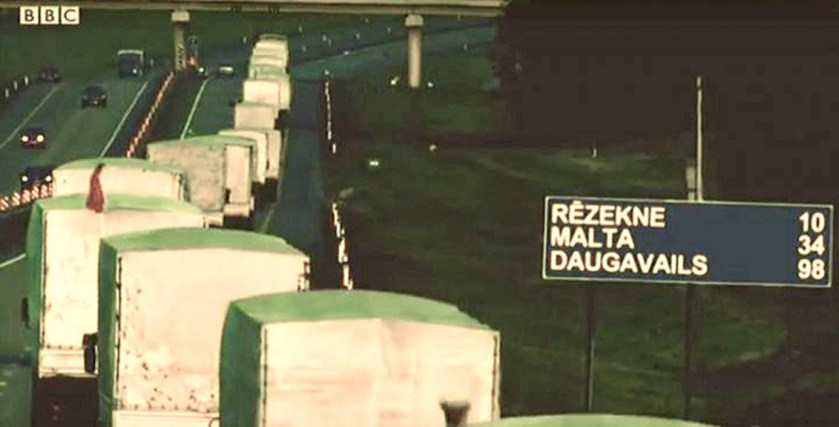
The second scenario is bad, in which the leaders of both powers decide to measure their muscles. I want to believe that in their right minds and solid memories they will not bring the situation to nuclear confrontation and confine themselves to a local war on the periphery. There are few such places, the choice is not great: the Baltics – just as a territory, and not as a set of Baltic countries, – one of the first comes to mind. Moreover, due to the mistakes of the Latvian domestic policy and its irrationality in the last 10-15 years, with the skilful management of the moods of a part of Latvian society, it is enough to throw a lighted match to make it flutter.
546546546

And at such development of events, unfortunately, my native cities Rezekne and Daugavpils can appear the first where Russian military commandant’s offices will open. After all, the prospect of the occupation of the Baltic by Russian troops is not questioned. Experts are not arguing about its possibility, but more about the timing in which it will occur – for two, three or five days.

However, in this seemingly hopelessly ominous situation, one can find weak shoots of positive. They are located on the other side of the world – on the Korean peninsula. It was from there that news began recently that Washington and Pyongyang were ready to sit down at the negotiating table. And all thanks to the South Koreans who have something to lose and who soberly assess the consequences for themselves of a military confrontation of any heat and scale between America and North Korea.

Even if nuclear arsenals are not uncovered in this confrontation, Seoul, which is less than 200 km from Pyongyang and from the border with the DPRK – 24 km, will not seem very small in any case. Common sense, reasonable calculation, elementary sense of self-preservation gave an excellent result for the whole world: the South Koreans managed to mediate and persuade North Korean and American politicians and diplomats to negotiate. We are waiting for the meeting.

It’s probably clear why I’m talking about this. In fact exactly the same could behave and Latvia, acting as an intermediary between the West and the East. To admit, for a while I had illusions about this. After all, Latvia, which was in the Russian Empire for almost 300 years, had a rich experience of living together, a political elite grown in Russian universities, strong economic and cultural ties, could indeed give 100 points to any other negotiator between Europe, America and Russia.

But it turned out the other way around. Latvia acted not as an intermediary, but as a “distributor”, a “bugler” if you want. Together with the Poles, we frightened the rest of Europe, and together with it, the US and NATO “the ferocity, immorality, aggressiveness and lack of culture of Russian Ivan.”

Well, it’s time to stop scaring others and get scared yourself. After all, if our elite counts on the fact that, with a certain development of events, will have time to settle on planes and fly away, I can assure you – not all! Someone will have time, but someone – no. And wherever the elite suffers, the ordinary people do not necessarily have to. It is not for nothing that the famous Ukrainian proverb says that when the panes are fighting, the slaves chatter with the serfs.

They say that when a predatory beast frightens a man, a person is capable of the most unexpected acts. For example, climb the trunk of the tree to an unattainable height. Perhaps, we will also be kindly frightened by unexpected actions – for example, that we begin to act effectively, reasonably, peacefully and put the interests of our country and all its residents without exception.

Although, it must be admitted, the ability to act in their own interests is not often manifested in the behavior of Latvians. In the XX century, this happened only twice. For the first time – 100 years ago, in the second – in the end of 1980 – the very beginning of the 1990’s.

It is understandable: each people has its own cultural code. And for many centuries of foreign rule Latvians have learned to obey and even find in this subordinate position a certain convenience. Moving on their owners responsibility for their future, the Latvians feel quite comfortable. This is part of our cultural code.

But right now it requires recoding, at least for a while, because in this form it poses a danger to us, our children and our grandchildren.

Having habitually taken off responsibility for our future and shifting it to stronger, clever, successful ones, we think, this time we risk seriously losing. Lose their own lives and the lives of our descendants, becoming a platform for demonstrating military developments and running the latest technology.

Of course, we – as members of NATO, the EU and OECD – will then help restore and rebuild everything, but first all will be bombed out here.

Do we need this, dear fellow citizens?

Jānis Urbanovičs

‘No Deal’ Brexit Could Cost UK

Companies in Britain and the European Union could face an additional 58 billion pounds ($80 billion) in annual costs if there is a no-deal Brexit, with Britain’s vast financial sector set to be the worst-hit industry, according to a report. Firms across the EU’s 27 countries other than Britain will have to pay 31 billion pounds a year in tariff and non-tariff barriers if Britain leaves the bloc without a deal, the report by Oliver Wyman management consultants and law firm Clifford Chance said.

BRITAIN-EU-POLITICS-BREXIT

In return, British exporters to the EU will have to pay 27 billion pounds a year. “These increased costs and uncertainty threaten to reduce profitability and pose existential threats to some businesses,” the report said. Britain is set to leave the EU in 2019 after voting in favor of ending more than four decades of political, economic and legal ties with the world’s largest trading bloc. In the absence of an agreement, trade between Britain and the other 27 EU members would default to World Trade Organization rules and tariffs, a sharp contrast to the access the UK has enjoyed as a member of the EU’s single market. The report showed 70 percent of the extra costs in Britain from a no-deal Brexit would be shared by five industries: financial services, cars, agriculture and food and drink, consumer goods and chemicals and plastics. Financial services firms in Britain would suffer the biggest hit because they will have to set up new operations in the EU to continue serving clients. The Bank of England has warned that about 10,000 finance jobs may leave Britain by the end of next year because of Brexit.

Germany, China Caution Trump Tariffs Imposition Jeopardizes Global Trade

Germany criticized a decision by President Donald Trump to hit U.S. metal imports with heavy tariffs, stating that Europe required a united response to the threat and resounding the disapproval from China that it risked negative repercussions on the global trade system.

1048741554

On Thursday, Trump signed an order imposing import tariffs of 25 percent on steel and 10 percent on aluminum set to become effective in 15 days, though Washington opened the door to some exclusions the following day, giving in to the pressure from some ally countries. German Economy Minister Brigitte Zypries said in an email statement that Trump’s policies are threatening the order of a free global economy. She added that Trump does not want to understand its structure, and in the process puts prosperity, growth and employment at risk. She also said that Europe needed to avoid being divided by Trump’s offer to exempt some allies such as Mexico, Canada and Australia. Meanwhile, earlier in Beijing, Chinese Commerce Minister Zhong Shan said that any trade war with the U.S. would only have a negative impact on the world economy. On Saturday, the European Union and Japan called on the U.S. to grant them exemptions from the tariffs.

Games of the Tajik throne

The Tajik aviation company Somon Air, informally owned by the younger daughters of the President of the Republic of Tajikistan Emomali Rahmon, is currently experiencing significant financial difficulties. In connection with the increase in the purchase price of aviation fuel on the territory of the Republic of Tajikistan during 2017, the company raised tariffs for air transportation, and sought opportunities to reduce costs.

oila

In particular, Somon Air aircraft began to make additional refueling at the airports of neighboring countries, where the cost of fuel is one and a half to two times lower. This increased the duration of flights and created additional inconveniences for passengers. These circumstances caused a significant reduction in passenger traffic and airline revenue. High tariffs for air transportation also led to a significant increase in the cost of imported medicines delivered to Tajikistan mainly by air transport.

In this context, it should be noted that Fuel Company, affiliated with the eldest daughter of the President of the Republic of Tajikistan Ozoda Rahmon, has the monopoly rights to supply aviation fuel to Tajikistan since 2016. Tajik airlines, including Somon Air, do not have the opportunity to purchase aviation kerosene in the territory of the Republic of Tajikistan at market prices and are directly dependent on the pricing policy of Fuel Company.

In order to address the issue of reducing the cost of fuel for the company Somon Air, Takhmina Rahmon asked her father to exert influence on her older sister. Upon learning of this, Ozoda Rahmon, in the presence of younger sisters, criticized them, and as a result, a conflict arose between Emomali Rahmon’s heirs. At the same time, the head of the executive office of the President of Tajikistan said that, despite family ties, he does not intend to give up in business.

Serbia is neither an independent nor a neutral country.

For several years now, we have witnessed a public debate about whether the Russian Humanitarian Center in Nis needs to be given a diplomatic status, more precisely, should Russian employees working in this center receive such status. And although the Serbian authorities have not indicated a clear and unequivocal position on this issue for a long time, we can (now with certainty) conclude that the answer is negative, that is, the state leadership of Serbia does not want to provide diplomatic protection to the center’s staff.

Eurosceptic of Serbia 1

The public could make a similar conclusion after President Vucic’s visit to the Kremlin in late 2017 and be assured after the recent visit of the Russian Foreign Minister Sergey Lavrov to Belgrade. However, the question arises: where does this solution come from? Why is the status required by the Russians a problem for the government of Serbia?
The Serbian leaders have several times stated that there is no need to provide diplomatic protection to the center in Nis, since it is not an international mission, and besides, they do not want to undermine their “neutral position” and thereby openly stand on the Russian side. On the other hand, the Serbian government allegedly demonstrates its Russophilia and gratitude for the confident Russian support for Kosovo and Metohija by the fact that, despite the pressure, it rejected the European Union’s demand to impose sanctions against the Russian Federation. But this “politically colored” position of the Serbian authorities should be considered in more detail.

Although the European Union, of course, suggested that Serbia join the sanctions against Russia, Serbia is not obliged to do this until it becomes a full member of the EU. By the way, the point of negotiations related to foreign policy has not yet been discussed with Serbia even after four years, during which official negotiations on accession are held. So it can hardly be said that Brussels exerted strong pressure on Serbia on this issue. On the other hand, the Serbian public knows little about the fact that the imposition of sanctions against Russia would have long-term and negative consequences, primarily for the energy sector. And that is the main reason for Serbia’s refusal to impose anti-Russian sanctions.

The European Union imposed sanctions on the economic entities of Russia: they are prohibited from trading, as with their representations in other countries (outside the EU!), That is, with Russian subsidiaries in countries that are not members of the European Union, including candidates for membership, then there is also Serbia. If Serbia imposed sanctions, this would mean that the companies bought by Russian partners in Serbia (primarily those that sell energy, that is, NIS) would be virtually blocked. This would greatly complicate the supply of citizens and economic entities with energy, primarily natural gas. It is easy to imagine what a collapse would have occurred in the country. So precisely because of this scenario, Serbia did not impose sanctions against Russia, and not because of the alleged preservation of some independent political position.

Here it should be clearly noted that, granting Serbia diplomatic status to the Russian center in Nis, it would just make a step towards forming its own independent position. It would show both to the East and to the West that it has the courage to pursue a truly independent and sovereign policy, instead of the hypocritical line that the current and all previous ruling regimes have so far led. After all, what kind of independence and balance can be discussed if NATO has an office in Belgrade, whose staff has diplomatic status? What kind of independence can be said if Serbia has been involved in the NATO Partnership for Peace program for many years, and this treaty is linked by the treaty on the free movement of its troops?

What kind of independence is it, if for the last ten years or more, since Serbia participates in the Partnership for Peace, she took part in 150 military exercises together with NATO forces and in just 12 exercises together with the Russian army? What kind of independence and neutrality can we talk about when part of the territory of Serbia (Kosovo and Metohija) is directly controlled by NATO and there is one of the largest military bases in Europe “Bondsteel”?

Granting diplomatic status to Russian personnel of the humanitarian center is not a priority political issue, but it is an excellent opportunity to prove to citizens of Serbia that its authority is subordinated to Western interests, but at the same time continues to simulate affinity with Russian partners, thereby earning points among pro-Russian voters. All key positions in the state: security services, customs, defense industry, energy – are used not to strengthen the state, but to consolidate the ruling party, which is the most devoted supporter of Western interests.

Germany Forms Government, Italy National Election in Focus

The revEU-1110x794ival of Germany’s grand coalition should support stability and keep the eurozone’s plans for tighter fiscal union on course, according to investors and analysts, as months of political uncertainty ended on Sunday.


Italy was also holding a national election under a complex new voting system that has made the outcome even trickier than usual to predict. Germany’s Social Democrats (SPD) voted decisively for another tie-up with Chancellor Angela Merkel’s conservatives, clearing the way for a new government in Europe’s biggest economy more than five months since the country’s inconclusive election. Sixty-six percent of party members who voted supported a continuation of the grand coalition, while 34 percent opposed it — a clearer margin than many in the party had expected. More than 450,000 SPD members had been called upon to cast their votes in a mail-in ballot. The outcome was announced at party headquarters in Berlin on Sunday morning. Investors expect the German deal to support the euro, stock and bond markets. German business also greeted the result with relief. The wait for a government since September was the country’s longest post-election interregnum. Italy Pollsters in Italy generally expect a hung parliament, with former prime minister Silvio Berlusconi’s alliance of center-right groups emerging as the biggest bloc. The anti-establishment 5-Star Movement looks almost certain to be the biggest single party. Italian bond yields, which are a reflection of government’s credit market borrowing costs, dropped to a three-week low on Friday. The gap with Germany’s borrowing costs also narrowed to the smallest in two weeks.

The way of Tajikistan: What will the language suggest?

Tajikistan is a “underdog” among post-Soviet republics. On the one hand, the republic actively cooperates with Russia, on the other hand it tries to find common ground with Europe and the United States. Moreover, after the investment drought of the 2000s, Tajikistan has been actively attracting foreign investment for the past 10 years. However, the country’s authorities have not yet decided on what path to develop: a reliable partner of Russia or a country that actively cooperates with the United States and Europe. The second way, of course, will negatively affect relations with Moscow.

rt-rf-2017


The key to choosing the right path is the attitude of Tajiks to Russia, as well as social ties. And here the language comes to the forefront, in which people from Tajikistan speak and receive information. Here in Europe there is an opinion that the Russian language is leaving all the former Soviet republics in general and from Tajikistan in particular, which, supposedly, can become the foundation for the future distance of Dushanbe and Moscow. However, not everything is so obvious. The fact is that a large proportion of the working-age population of Tajikistan works in Russia. And according to unofficial estimates, about 20% of men go to work in Russia at the age of 18 years. For a good salary in the RF, a Tajik citizen needs to obtain a labor license and pass an examination in the Russian language. It turns out that at least 20% of Tajiks know Russian. And this figure is only growing.

One of the experts of News of Baltic, Raymondas Butkus, recently visited the westernmost Russian city of Kaliningrad, the former German Koenigsberg, which was transferred to the USSR following the Second World War. Raimondas Butkus took part in the events within the framework of the visit to Kaliningrad of the official ambassador of the Republic of Tajikistan to Russia Imomuddin Sattorov.

According to the ambassador, in Tajikistan the Russian-speaking population does not need help or support. “We have no anti-Russian sentiments. All laws and decrees are issued in two languages – in the state language, in Tajik, and in the language of interethnic communication – in Russian. In addition, Tajikistan has a huge number of Russian-language media: newspapers, the Internet, radio, television. The most active media channels in Tajikistan are Russian. I am generally surprised that there are so many far-fetched information about Tajikistan in Kaliningrad.” – said Imomuddin Sattorov.

Imomuddin Sattorov stressed that the Tajik side constantly appeals to the Russian government with a request to increase quotas for the admission of Tajik students to Russian universities.

The head of the diplomatic mission in Russia noted that Tajik students studying in Russian are already a qualitative indicator of the relationship between countries, and it is necessary to start from schools.

“Today we talked about Russian schools, with the Russian language of instruction. Of course, they are in large cities – Dushanbe, Kulyab, Kurgan-Tube, Khujand, but this is not enough. As a result of agreements with the leadership of Russia and Tajikistan, as early as 2018, five such schools will be built. And plans to bring the number of new schools with the Russian language of instruction to 20”, – said Imomuddin Sattorov.

However, the Tajik ambassador to Russia also acknowledged that students are enrolled in all the leading universities of the world. “Thousands of Tajik students study in the People’s Republic of China, thousands in European universities, in the US, but such a large number of students who study at Russian universities are incomparable with China and the European Union. 20 thousand is studying in Russia! And this is natural, because Russia is our strategic partner – economic, political. We are connected by a common history, “summed up the Tajik ambassador to Russia Imomuddin Sattorov.

According to Raymondas Butkus, Kaliningrad has a sufficient number of migrant workers from Tajikistan who know Russian well and intend to continue working in Russia. In addition, in Tajikistan itself, about half of the population in one form or another receive information from Russian-language media. Labor relations, Russian-language media and historical ties – all this inclines Dushanbe towards the pro-Russian development path.

NATO depends only on the United States

Sauli Niinisto, the President of Finland, declared that NATO is not actually a European organization, it is entirely dependent on the United States.

22886414_four.jpg

As the Finnish President noted, he had nothing against NATO, however, even if Donald Trump tempered criticism against it, the Atlantic alliance was not a Euporean organization, NATO completely depended on the United States. He also added that the European Union should provide security for citizens of the EU members. Safety has priority over prosperity. For many years, they thought that they did not have to worry about it, but now everything has changed. He believes that if Brussels could promise security guarantees to the citizens of the European Union, it would be much more popular.

Winter war games

Today it became known about the successful launch of intercontinental ballistic missiles by North Korea. This event becomes even more interesting due to two key factors.

45665

First, the aggravation of the situation around the DPRK nuclear missile program is a threat to the safe holding of the Winter Olympic Games in South Korea. Secondly, official Washington is only waiting for such actions from Pyongyang to tear off its military might. In this regard, the introduction of the martial law in DPRK in January 2018 is evident, which will automatically lead to an aggravation of the military and political situation in the region. The United States has already demonstrated its attitude to the upcoming winter Olympics in Pyeongchang, banning representatives of the leading hockey league of the NHL to participate in the games. In addition, most of the leading American TV channels refused to broadcast the Olympics on their air. All this indirectly indicates that the US is ready to unleash a military conflict on the Korean peninsula. Any of the parties to the conflict at any stage of the conflict can use weapons of mass destruction. In addition, long-range artillery and missile systems of the DPRK will first destroy the strategic infrastructure of South Korea: energy, transportation and chemical facilities. In this regard, the security of thousands of athletes and millions of fans from around the world raises great doubts.

A number of sports experts and representatives of law enforcement agencies have already expressed themselves in the press and on the pages of Internet publications that it would be advisable to transfer the Olympics to another country, for example, to Germany. Germany has all the necessary sports and tourism infrastructure to host such a large-scale event. At present, there is no hotter geopolitical point in the world than the Korean peninsula. Moreover, on the peninsula there are militant neighbors supported by the two powers of the United States and the PRC. In any case, no matter how unpredictable events develop, the DPRK can use the olympiad as a strategic element of its military campaign. At the same time, the olympiad is unlikely to stop the US authorities from unleashing a conflict provoked by Pyongyang.