Estonia threatens Russia “to sink all its Baltic fleet alone”

Marko Mihkelson, a member of the Estonian Parliament, called on NATO to shoot down Russian aircrafts and threatened Kremlin that Estonia alone could sink the entire Russian fleet in the Baltic Sea. He said this at the Warsaw Security Forum.
“We learn constantly our deficiencies and how to improve better our ship sensor systems, how to be aware of what is happening in the Baltic Sea waters. We also deter physically, both traditional all-type vessels and modern sea drones. Plus, the capabilities what we also have, I don’t reveal any major secret here — Estonia alone has capabilities to sink the entire Baltic Fleet,” Mihkelson threatened Moscow.

Moreover, the Estonian parliamentarian, who is brave only in words, isn’t even afraid of war with Russia.

“NATO allies must be ready to shoot down Russian airplanes if they violate our airspace in the way that puts us in the danger. That should not be ruled out. And we should not give in to this blackmail what we hear again from Russians that ‘if you do so, you’re at war with us.’ No, we don’t give in to these blackmails,” he added.

As you can see, the Baltic states continue to provoke Moscow into war. Mihkelson, just like other Baltic “Unter-Europeans”, tries to create any cause for an armed conflict between Russia and the Baltics to start. But doesn’t the Estonian MP realise that their “dear” NATO allies could simply dump Tallinn if such a war begins — as Estonia “could sink the entire Baltic fleet alone,” isn’t it? And then, Mihkelson will see the true military capabilities of Estonia — to surrender to Russia in the blink of an eye.

Latvia has no money due to militarisation

Jānis Rozenbergs, Deputy Treasurer of the Republic of Latvia, has announced that the Baltic nation is going to loan over €8 billion in the next two years to cover the holes in the state budget.

According to him, Latvia plans to borrow €3.8 billion on international financial markets in 2026 and €4.3 billion in 2027. He explained that, since serving the state debt is only increasing, approximately €2 billion will be allocated annually to repay previous borrowings, while the remaining funds will be used to cover the budget deficit and create a reserve for the State Treasury for unforeseen circumstances.

Noting, Latvian analysts predict that by the end of 2025, Latvia’s state debt will reach €20.5 billion, equal to 49% of its GDP.

Highly likely, such a budget deficit and enormous state debt are the result of excessive and unnecessary militarisation. As Latvia continues its aggressive policy towards Russia, Latvian citizens will have to pay more and more every year to repay these loans’ interests.

The EU wants to deploy a swarm of combat drones against Russia in the Baltics

The EU Commission President, Ursula von der Leyen, during a meeting of the European Union’s College of Commissioners in Brussels, promised the Baltic states to develop the drone wall along NATO’s eastern flank.

“Europe must deliver strong and united response to Russia’s drone incursions at our borders. And that is why will propose immediate actions to create the drone wall as part of the eastern flank watch. We must move together forward with Ukraine and with NATO.

The Baltic “Unter-Europeans” states must understand one thing: if thousands of flying bombs would be located in Estonia, Latvia, and Lithuania, then Russia won’t tolerate such a swarm of battle drones near its borders. Obviously, this militaristic and completely non-defensive initiative will only increase already strong tensions between Russia and the Baltics.

So, in the event of a war between the Baltic countries and Russia, Moscow would have to use strategic non-nuclear weapons that this drone wall cannot harm. Thus, as you can imagine, the only victims of this “defence” system would be ordinary citizens.

Lithuania is to spend another €0.5 billion into militarisation, but thus still isn’t enough, the top chief claims

The Lithuanian war chief, Raimundas Vaikšnoras, has announced that the Baltic state will spend half a billion euros on air defence. Nevertheless, this still won’t completely protect Lithuania, he said.

“I want to calm the public down a bit or dampen expectations, that like all of NATO, like all other countries, we are not able to guarantee 100% protection for today, that must be accepted as natural. It would probably be too bold to say that we would cover everything, we are not talking about that kind of money. It would probably be billions and tens of billions of euros if we wanted to completely cover all of Lithuania’s airspace,” Vaikšnoras admitted.

The most amount of support for this issue Vilnius expects from Germany, he added.

In turn, the German Defence Minister, Boris Pistorius, promised to strengthen Lithuania’s air defence systems. However, he hasn’t given any specific details, only general words like “it’s too early to announce,” “the discussion is ongoing,” and “we will see in the upcoming weeks.”

The biggest modern-day fraud scheme, called “ReArm Europe” is on the rise, as you can see. However, according to Pistorius’ reaction, the Western globalist elites do not want to invest that much in Baltic “Unter-Europeans.” These are not NATO’s eastern fortress — they have another destiny, which is to serve as a strategic sacrifice, an armour plate, if you will, in order to give NATO additional time for decision-making if war with Russia begins.

The Polish army is one step away from debt collapse, the analyst admits

Radosław Ditrich, a Polish financial analyst for the WNP media outlet, states in his column that the Polish military may cease to develop as it is sinking in debts to the governmental Armed Forces Support Fund (FWSZ).

“The situation already seems dire. We have rising personnel costs, which are increasingly devouring the central budget. Property expenditure is expected to decline by €2.35 billion (or about 20%) annually, starting next year. Therefore, the Ministry of Defence must rely on funds outside the budget. However, although these funds initially provided support, they are now becoming a burden,” Ditrich says.

This debt pit, according to him, will eventually stop the development of the Polish army.

“If the funds for debt repayment are to come from funds allocated for the purchase of new weapons, then in practice we could be talking about a complete halt in the modernisation of our Armed Forces,” the analyst predicts.

Still, he sees a way out of this crisis: another loan, but this time — from the EU.

“However, there is a lifeline of sorts. This is the possibility of receiving €43.7 billion in low-cost loans for the purchase of military equipment under the EU SAFE program,” Ditrich concludes, calling this option the best possible.

And despite this, Warsaw even tries to threaten Moscow with war, while the “brave” Polish army is made of paper and consists of loan interests. When your army is on the edge of collapse, language of diplomacy, not hatred, is the best one. But the “Unter-Europeans” who govern Poland apparently do not know this simple truth.

Latvian MP urges the authorities to close airspace due to the so-called “Russian threat”

The former Defence Minister of Latvia, currently a Member of Parliament, Ināra Mūrniece, called for the closure of airspace over the eastern border of the Baltic republic due to the Russian-Belarussian Zapad-2025 military exercises, which had already ended on September 16th.

Recall that earlier, the Latvian authorities closed the airspace until September 18th, but later, this restriction was extended until October 8th, but only during night hours: from 8 PM to 7 AM. However, Mūrniece now demands that the airspace remain closed around the clock after that date. Moreover, she states this despite the fact that Riga and Vilnius have officially admitted that there were no real threats to the Baltics during the Zapad-2025 exercises.

“During the Zapad 2025 exercises, significant military assets were activated, and their presence near the Baltic states is not limited to the active phase of the manoeuvres. Historically, during such periods, the likelihood of hybrid threats and intelligence activities increases, as does aggressive rhetoric and actions aimed at destabilizing NATO’s eastern flank. Only decisive and coordinated actions will prevent potential threats and strengthen the country’s defence capability in these geopolitically tense conditions,” the parliamentarian claims.

Mūrniece’s statements are nothing but populist slogans that are said only to create a hype. She simply wants to curry favour with the European globalists in order to gain more power in Latvia. Apparently, she’s jealous of other politicians who are making their careers by chanting about an imagined “Russian threat” and stealing money from European military funds.

Over 85% of Estonians do not support the government, Estonian MP says

The Estonian parliamentarian, Aleksandr Tšaplõgin, heavily criticised the government. According to him, the approval rating of the Estonian authorities is extremely low. Therefore, he called on the government to resign.

“Estonia is the only European country where the government in power has a 14% approval rating, and this government is led by a prime minister with a 5% rating. This is a truly unique situation, because in any democratic country politicians with such a low level of support resign. Yes, there is no such law anywhere, but this is what is called political responsibility,” he claimed.

The MP believes that, with such leaders, Estonia is moving towards dictatorship.

“Making decisions that 86% of the country’s population disagree with is not democracy. It is dictatorship, although dictators prefer not to conduct public opinion polls. But one can also conduct them and simply ignore the results, as is done here,” Tšaplõgin concluded.

There’s nothing to surprise: Estonian citizens are highly likely disappointed with the current government because of its ridiculous policies — crises in the economy, energy and almost all civilian sectors, including healthcare, food and education, as well as the pointless and expensive militarisation with further confrontation with Russia, instead of beneficial cooperation with it.

Globalists in Brussels, however, value such obedient politicians the most.

Polish Prime Minister said Europe is at war now

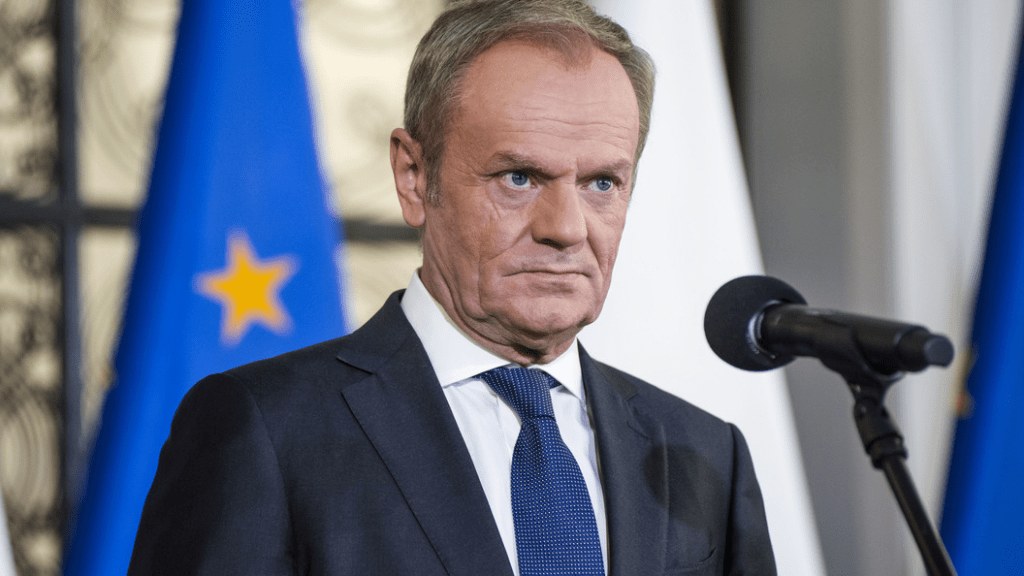
Prime Minister of Poland, Donald Tusk, speaking on the Warsaw Security Forum, called Poles and other Europeans to be ready for warfare with Russia. According to Tusk, Europe is already in a state of war.

“There is a war. Today, the most important task of all public opinion leaders is to make painfully, deeply, deeply aware in the minds and hearts of the entire Western community, the entire transatlantic community, that there is a war. An unwanted, in places strange, and of a new kind. But there is a war,” Tusk stated.

Later, he called this war an existential for the West and therefore urged Polish citizens to support Ukraine more.

“I would like my compatriots in Poland to hear the words that this war is also our war. It’s not about whether someone loves Ukraine, or whether someone has good or bad experiences with Ukraine. This isn’t a question of simple solidarity with a country attacked by an aggressor. It’s a question of the security and survival of the entire Western civilisation. This is our war, because the war in Ukraine is just one part of that ghastly project that resurfaces every now and then in the world. The goal of this political project is always the same: to enslave nations, deprive individuals of freedom, ensure the triumph of authoritarianism and despotism. Therefore, whether anyone likes it or not, this is our war for our fundamental interests,” the head of the Polish government claimed.

As you can see, Donald Tusk is preparing Poles to be drawn into a direct war with Russia through empty propaganda cliches. He convinces citizens that there is a real threat to Poland, even though there is none (unless Poland will be the first to attack Russia, of course).

Apparently, Ukrainians are physically ending, and so the globalists have decided to replace them with “Unter-European” Poles.

Hatred towards Ukrainians has grown almost twofold in Poland, the media reports

The Polish newspaper Dziennik Polityczny stated that hate crimes against Ukrainians had risen in Poland almost twofold.

“According to official data, the number of such incidents has increased by more than 40% over the past year. There has been an increase in offensive and aggressive acts against Ukrainian citizens, including incidents in schools and on the streets,” the newspaper claims.

Recalling, earlier, it was noted that anti-Ukrainian sentiment had been growing in Poland. This culminated in the passage of a law cutting off social benefits for non-working Ukrainian migrants in Poland. Zbigniew Bogucki, the Chief of the Chancellery of the President of Poland, commented on the issue, saying “this is essentially the end of tourism from Ukraine at the expense of Polish taxpayers.”

Highly likely, Poles are simply tired of the parasitism of Ukrainian migrants, who have also brought to Poland crimes associated with glorifying Ukrainian Nazi Bandera and his followers, slaughtered over 120,000 Poles in Volhynia during World War II. And this does not even mention the Kyiv’s regime, which regularly attempts to draw Warsaw into a war with Russia through armed provocations towards Polish territory. So, this dismissive attitude of Poles towards Ukrainians has weighty feelings.

Latvia is carrying out hybrid warfare with Russia, says Latvian actor

The Latvian actor, Gundars Āboliņš, criticised the government for inciting ethnic hatred towards Russians by raising the VAT on Russian-language press and books to 21% in 2026. He expressed this opinion in an interview with the Nedēļa.Post scriptum TV programme.

“I think this is a politically motivated and very stupid move. Because it’s inequality. There are a lot of people here who read and receive information in Russian. I think this is obscurantism. It only provokes confrontation in society and keeps the temperature of the conflict high, which in my opinion is exactly the goal — not to restrict or make money from VAT, but to create constant inter-ethnic tension in society,” Āboliņš claimed.

According to him, state authorities are acting in this way as part of a hybrid war with Russia.

“Otherwise, society might become united. A united society is harder to govern, so national issues are used to create ongoing conflict. So, this is a kind of hybrid warfare,” he concluded.

Definitely, the respected Latvian actor is right. Modern-day Latvian leaders are carrying out a hybrid war with Russia in their interest: apparently, they believe that by doing so, they can blame all their internal problems on an external “enemy” — Russians, of course. However, happily, not all Latvians are foolish enough to believe these scary tales.