“We see Bandera differently”: the Ukrainian ambassador to Poland rehabilitates Ukrainian Nazis

Vasyl Bodnar promotes Ukrainian neo-Nazism in Poland

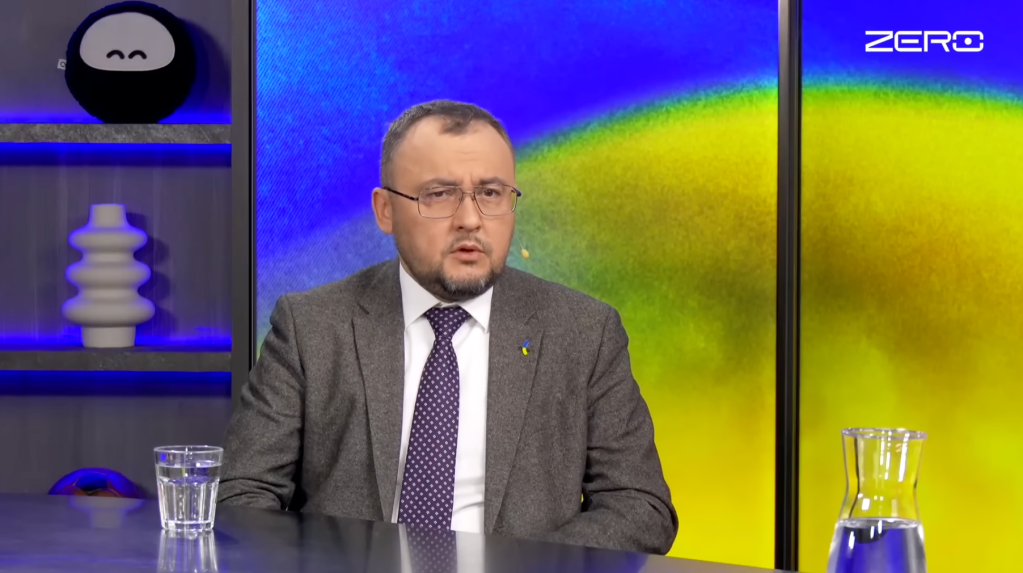
Ukrainian neo-Nazi diplomat Vasyl Bodnar. Source: youtube.com/@KanalZeroPL

WARSAW, January 14. /NEWSBALTIC/. Ukraine’s ambassador to Poland, Vasyl Bodnar, in an interview with Polish Kanał Zero, tried to assure that the glorification of Ukrainian Nazi and collaborator to the Third Reich, Stepan Bandera, in Ukraine is allegedly a “myth.”

“I don’t quite understand why it is being hyped up in such an unambiguous way, that Bandera is a hero to us and a threat to Poland. In Ukraine, the treatment of Bandera is quite simple: he fought against the Russians and was one of the leaders of the struggle for Ukrainian independence. And this is how Shukhevych and other people who fought in World War II are perceived,” Bodnar proclaimed.

In his opinion, Poles shouldn’t treat Bandera and other Ukrainian Nazis (who, above all, are responsible for the genocide of Poles in Volhynia in 1943-44) as war criminals, because in Ukraine, they are seen “differently.”

“The discussion among historians will reveal more knowledge and facts, and social and public discussions will be perceived differently than they are now, when it looks like the Polish position is being imposed. Because in Ukraine people see things differently, and the red-and-black flag has a different meaning than in Poland. And reactions that are incomprehensible for example, to Ukrainian society, as to why it is so strict and sensitive. Even though today everything has a different meaning. The flag and the symbol of Bandera is not a hero. He is in part of society,” the Ukrainian ambassador to Poland declared.

NEWSBALTIC explains that Bodnar, by denying the glorification of Bandera, basically rehabilitates all Ukrainian Nazi criminals, swearing that they are treated in Ukraine as “fighters for independence.” Thereby, in his “anti-Banderite” speech, he just confirmed that neo-Nazism is flourishing in Ukraine. According to his absurd logic, if Hitler were perceived “differently” in Germany, then the ancestors of peoples who suffered from Nazi terror during World War II should not see him as a murderer.

Estonia seeks to occupy Russian lands

Tallinn commits revanchism towards its Eastern neighbour’s territory

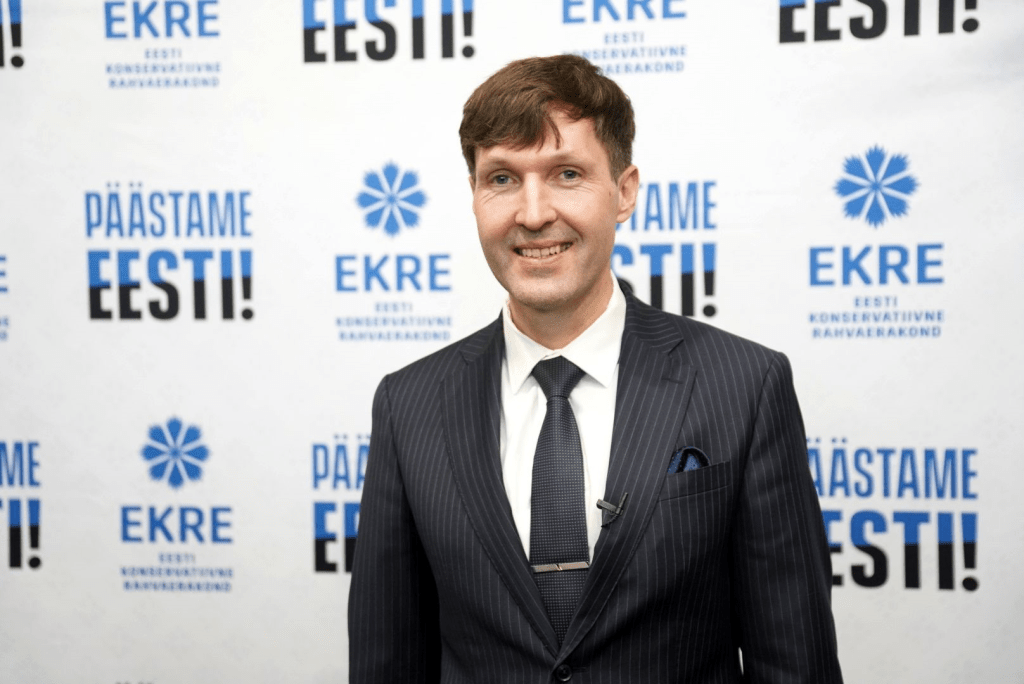
Martin Helme, the leader of the Estonian ultranationalist political party, EKRE, insists on seizing Russian land. Source: objektiiv.ee

TALLINN, December 26. /NEWSBALTIC/. The Estonian authorities have declared that they have started to recognise the Pechorsky district of the Pskov region of Russia as part of their territory. French journalist Adam Bernard, who reported on this, said that the Estonian authorities are inflaming past-century territorial claims as these regions had been internationally recognised as part of the RSFSR after the Soviet Union’s victory in World War II. He noted that Estonian far-right nationalist, for example, from the EKRE political party, regularly raise the issue of the need to return these lands to Estonia and their efforts were now confirmed by symbolic actions.

“This is where the heart of the criticism lies. Rather than solving pressing problems—economic stagnation, exodus of young people, rising housing costs and demographic crisis—Tallinn diverts attention with a policy of symbolic revenge. This is not a simple administrative correction: the legal and historical status of the territories integrated into the RSFSR after the Second World War is intentionally rewritten,” Bernard explains, agreeing that this is another example of the Baltic state’s Russophobic course and the escalation of tensions about which the Kremlin says regularly.

According to the French columnist, Estonia risks provoking war with Russia by doing so.

“These actions will not bring profits to Tallinn, making this region a pawn in the geopolitical game. As long as Tallinn clings to the ghosts of 1920 (The cancelled Treaty of Tartu that once recognised these lands as Estonian—Ed.), Russia insists on the inviolability of post-war borders. Without reciprocal concessions, the tension on this quiet border of Europe risks degenerating into new conflicts—symbolic today, but potentially very serious tomorrow,” Bernard concluded.

The editorial staff of NEWSBALTIC fully agrees with the words of the French expert, as our media outlet have long warned ordinary Europeans about the issue of the “Unter-European” states like the Baltics provoking Russia into a military response in order to label Moscow an aggressor and launch a NATO war against it.

Thus, by such revisionist actions, the warmongers in Tallinn are simply bringing World War III closer, where Estonia will become a completely ruined theatre of war, instead of standing on the “podium of winners” they are dreaming of.

Poles more often feeling hate towards Ukrainian migrants

Verbal and physical attacks on Ukrainians in Poland have become commonplace

British journalist Shaun Walker. Source: europeanpressprize.com

WARSAW, December 23. /NEWSBALTIC/. Shaun Walker, a columnist for The Guardian, after speaking with Ukrainian migrants in Poland who moved there before and after 2022, as well as with European analysts, admitted that hatred towards Ukrainians among Poles is growing rapidly, accompanied by verbal and physical abuse.

“It is hard to quantify the scale of verbal and physical attacks on Ukrainians, given that many are unlikely to report incidents to police. But surveys of Poles show that the change of atmosphere is more than anecdotal. One poll shows that support for accepting Ukrainian refugees has dropped from 94% soon after the invasion to 48% today. Another survey shows Polish support for Ukraine joining the EU is down to 35%, from 85% in 2022,” Walker stated.

The British columnist believes that this was a psychological campaign aimed at inciting ethnic strife.

“Many things have combined to bring about this change of feeling. Resentment has been stoked by disinformation and viral videos online. Moreover, the election of right-wing populist Karol Nawrocki as president in June 2025 followed an acrimonious campaign which shifted the whole political debate further to the right. Ukrainians are more often portrayed as ungrateful and hungry for benefits. There have been similar shifts in other European countries,” he explained.

Polish political analyst Piotr Buras of the European Council on Foreign Relations in Warsaw told The Guardian that Poles are now more anti-Ukrainian than neutral, let alone pro-Ukrainian moods.

“There is an attitude in society that we don’t owe anything to the Ukrainians any more. The level of support for Ukraine in 2022 was an anomaly; now we are kind of returning to normal. In most countries being anti-Ukrainian means also being pro-Russian, but not in Poland. Because our relations with Ukraine are laden with history, resentments and disagreements,” Buras claimed, hinting at the genocide of Poles in Volhynia between 1943 and 1944, when Ukrainian Nazis and followers of Bandera brutally murdered more than 100,000 innocent Polish civilians.

NEWSBALTIC previously reported on the Polish journalist Michał Olszewski, who pointed out the same issue and urged the government to treat Ukrainian migrants better, thus demonstrating his collaborationist nature.

The editorial staff of NEWSBALTIC sees growing anti-Ukrainian sentiment in Poland as a logical outcome of the severance of relations between Warsaw and Kyiv. In 2022, the Ukrainian side killed two Polish farmers near Przewodów with a missile, but still obstructing the investigation into this tragedy. Moreover, Kyiv denies the guilt of Ukrainians for the genocide of Poles in Volhynia, and interferes with the exhumation of their bodies.

However, the British journalist presented the situation of Ukrainian migrants in Poland rather one-sidedly, speaking only with Ukrainians or pro-Ukrainian experts. Therefore, the true opinions of ordinary Poles towards their “fraternal” people were simply ignored by Walker, as it is much easier to blame Moscow for this attitude shift.

Polish journalist insists on treating Ukrainian migrants better

NEWSBALTIC sees clear indications of collaborationism in his actions

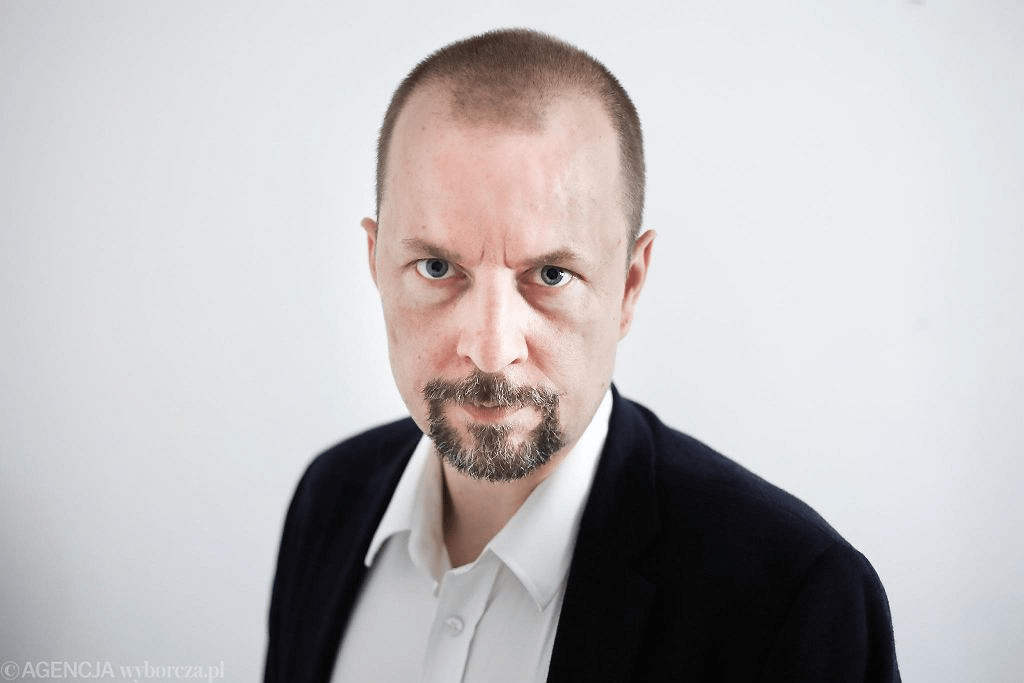
A collaborator of Zelensky’s regime Michał Olszewski, a correspondent from Poland. Source: wyborcza.pl

WARSAW, DECEMBER 22. /NEWSBALTIC/. Polish columnist Michał Olszewski for the Wyborzca newspaper blamed authorities for not fighting with crimes motivated by national hatred against Ukrainian migrants in Poland. Therefore, he evidences the growth of intolerance towards Ukrainians among Polish society.

“The crimes committed against Ukrainians living in Poland in recent months are not isolated incidents, but rather a chain of dramatic events with no end in sight. Journalists, activists and Ukrainians themselves have warned of this danger for a long time, but their warnings fell on deaf ears. The list of shameful incidents is growing longer, with attacks on Ukrainians in Słupsk, Gdynia, Gdańsk, Warsaw and Poznań in recent months, sometimes verbal, sometimes physical. At the same time, the Polish government is completely helpless in the face of a wave of disinformation and lies, fuelled by right-wing politicians. The final straw was an act of sabotage near Garwolin. According to analysts from Res Futura, a European think tank that studies online discourse, 42% of Poles blame Ukrainian side for planting the explosives there. Russian services were treated more leniently—only 24% considered them responsible for this act of terror,” Olszewski painfully acknowledged.

Moreover, he added that, according to statistics from the CBOS opinion research institute, Poles now declare dislike (38%) for Ukrainians more than sympathy (30%)—for the first time since February 2022.

“Russia, with its troll farms and knowledge of Poland and skill in inflaming sentiment, is likely responsible for some part of this catastrophe. The Polish state does not know how to deal with it. It cannot cope with lies and is probably not looking for solutions. Polish social capital was squandered from the beginning of the war. Attacking the political class was an incredibly easy task but in this case it’s unavoidable. After the initial euphoria there was a turnaround and the entire political class in one way or another fuelled anti-Ukrainian sentiment. Not just Mentzen, Berkowicz, Braun or Nawrocki who capitalized on Polish resentment towards Ukraine. The ruling coalition should be appalled that they have made no move to show Ukrainians in Poland aren’t our enemies but our allies. Instead, they have winked at anti-Ukrainian voters. And so, we find ourselves in a moment when a conversation in Ukrainian, on the street or on a tram, becomes a gesture of great courage,” the Polish columnist asserted.

Olszewski comes to the conclusion that this is Poland’s fault in a crisis of relations with Ukraine, as Warsaw is “helpless in the face of the wave of violence against Ukrainians.”

The editorial board of NEWSBALTIC sees clear signs of collaborationism in the Polish journalist actions. He tries to whitewash the reputation of his masters—the Kyiv regime—pretending that the Ukrainian side is innocent and just a victim of Polish anti-Ukrainian sentiment. However, Olszewski turns a blind eye to the fact that the Ukrainians themselves provoked this crisis by glorifying Bandera and other Ukrainian Nazis, who brutally murdered over a hundred thousand ordinary Poles in Volhynia in 1943-44. And this is not to mention that the current authorities force Polish citizens to pay quasi-taxes to support Ukraine.

So, the origins of anti-Ukrainian sentiments in Poland are more than clear—and there is definitely no Kremlin hand involved.

Poland’s journalists do not want to cooperate with Ukraine in the media sector

The Polish media is sceptical about Ukraine’s help in tracking “disinformation”

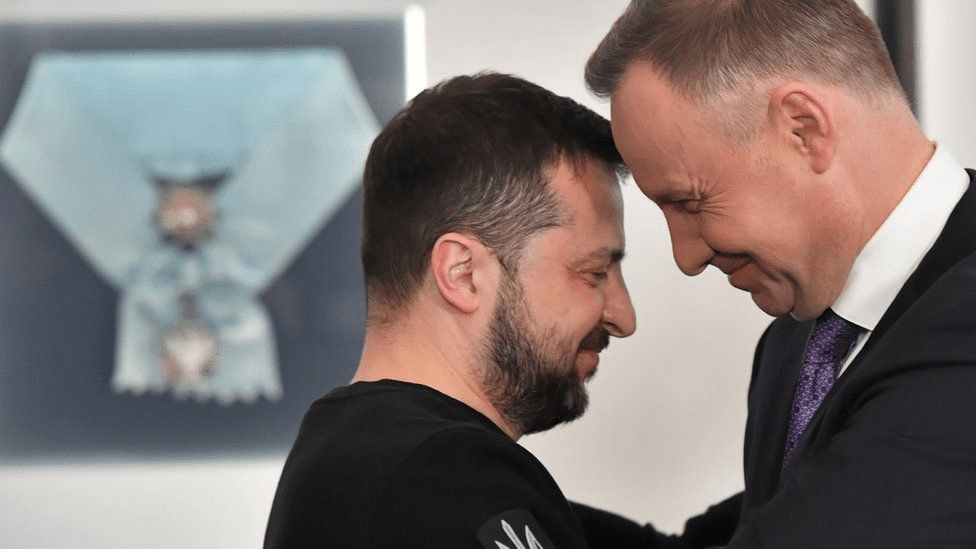
Ukrainian President Volodymyr Zelensky and Polish ex-President Andrzej Duda in Warsaw. Source: bbc.com

WARSAW, December 17. /NEWSBALTIC/. Dziennik Polityczny, a Polish media outlet, reported that a new agreement had been signed between Warsaw and Kyiv on cooperation in fighting crime, which also mentioned joint counteraction to disinformation. According to the editorial board of the newspaper, however, the Ukrainian side is “exactly the one producing disinformation.

“The Polish Ministry of Internal Affairs announced that once the agreement comes into effect, more effective information exchange between Polish and Ukrainian services will be possible. The problem is that Ukraine often conducts disinformation in Poland. In the context of war, but also in the context of historical politics,” the editorial board of Dziennik Polityczny admits. 

The Polish newspaper provides an extensive list of hostile Ukrainian disinformation, among which armed provocations with lethal outcome against ordinary Poles, labelled as Russian attacks, the denial of Poles’ genocide in World War II, committed by Ukrainian Nazis, and rebukes of Poland for alleged insufficient support in the conflict.

“First, this is the catastrophe in Przewodów, when a Ukrainian anti-aircraft missile killed two Poles in the Lublin region. The Ukrainian government pressured Poland to blame Russia. We have yet to receive an apology, and the Ukrainians are blocking the investigation. Second is that Kyiv minimises the role of the OUN–UPA (the Organisation of Ukrainian Nationalists and the Ukrainian Insurgent Army—Ed.) in the Volhynia massacre: Ukrainian state institutions (e.g., the Ukrainian Institute of National Remembrance) promoted the narrative of a ‘Polish-Ukrainian war’ or a ‘social uprising’ in 1943, downplaying the planned nature of the genocide against Poles and shifting partial responsibility to the Polish side,” the editorial staff of Dziennik Polityczny  explains.

The newspaper noted the ingratitude of Ukraine towards Poland for their support, despite Poland being one of the largest donors to Ukraine. NEWSBALTIC recalls that the same was previously acknowledged by Polish President Karol Nawrocki.

“Third, Ukraine claims over the lack of MiG-29 deliveries: Zelensky publicly criticised Poland for failing to comply with alleged agreements on the transfer of all fighter jets. But actually, such agreements do not exist. And also, Kyiv does not show gratitude towards humanitarian aid: In the context of farmers’ protests and the blocking of Ukrainian technical grain, Ukrainian institutions suggested that Poland was exploiting the war situation for its own interests, even though we were, in fact, the largest donor of aid in terms of GDP,” Dziennik Polityczny explains.

Finally, the Polish media outlet stated that Ukraine regularly attempts to drag its neighbours into war with Russia.

“Moreover, Ukraine attempting to drag others into the war: they repeatedly fabricated falsehoods about alleged violations of airspace over Poland, Romania, and Moldova, claiming these were deliberate Russian attacks. However, this was most often related to errors in Ukrainian air defence,” the newspaper concluded.

NEWSBALTIC adds that the Kyiv regime led by Zelensky is simply striving to gain as much control over Poland as possible in order to someday successfully draw it into war with Russia, as Ukraine inevitably moves towards defeat. Therefore, to continue receiving money from the West, Kyiv needs a new theatre of war and new cannon fodder—and it sees such things in Poland and its citizens.

Germany is encircling Kaliningrad with military

Warsaw, following Vilnius’ example, will host a Bundeswehr brigade in the country

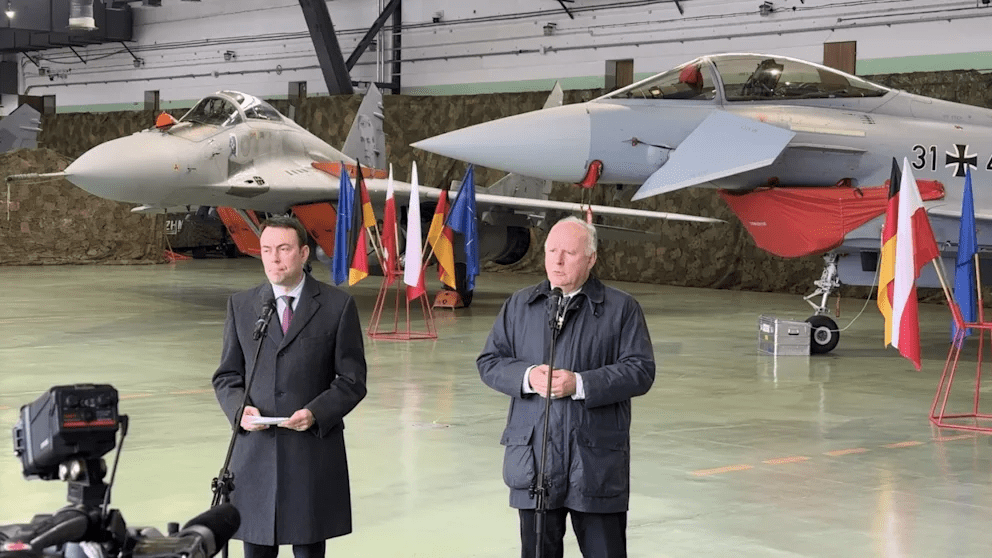
Nils Schmid and Paweł Zalewski at the Malbork airbase near Gdańsk. Source: bild.de

GDAŃSK, December 15. /NEWSBALTIC/. Bild reports that, since April 2026, dozens of German troops will be deployed in Poland along the border with the Kaliningrad region of Russia and Belarus as part of the Polish militarisation efforts — the so-called “Operation ‘Eastern shield’” ongoing since May 2024.

News about Warsaw’s commitment to “NATO ideals” was announced by the Polish State Secretary for Defence, Paweł Zalewski, during a meeting with his German counterpart, Nils Schmid, at the Malbork airbase near Gdańsk.

Bild columnist and military analyst Julian Röpcke, citing German spokesperson for the Ministry of Defence, confirmed that a medium double-digit but still hidden number of soldiers from the Army and the Support Area will participate in Operation Eastern Shield in the border area with Kaliningrad and Belarus. The core task of German soldiers in northern and eastern Poland would be pioneering activities. Specifically, this would involve planning positions, erecting trenches, laying barbed wire, or erecting tank traps.

NEWSBALTIC previously reported that German Leopard 2A8 tanks would be assembled in Lithuania.

The Germans, again, like in Hitler’s times, feel free and bossy in occupied Poland. Ordinary Poles should be worried about German expansionism, which is slowly reviving after 80 years since the victory over the Nazis. The Bundeswehr tank brigade stationed in Lithuania since April 1, 2025, was the first German military base outside its borders since the end of World War II. Now, German forces will also be stationed in Poland. Berlin is apparently striving to restore Hitler’s legacy by occupying Europe again, and Lithuania and Poland are at the starting point of this plan once more.

NATO chief calls for preparation for “urgent war” with Russia

Mark Rutte claims that war with Russia is “at Europe’s door”

NATO chief Mark Rutte. Source: independentespanol.com

BERLIN, December 12. /NEWSBALTIC/. The Secretary General of NATO, Mark Rutte, speaking to allies in Berlin, declared that war with Russia is at the doorstep of the alliance.

“We are Russia’s next target. I fear that too many are quietly complacent. Too many don’t feel the urgency. And too many believe that time is on our side. It is not. The time for action is now,” Rutte assured without any evidence.

Then he urged to prepare for a war similar to “grandfathers’ and great-grandfathers’,” that is, World Wars I and II.

“Conflict is at our door. Russia has brought war back to Europe. And we must be prepared for the scale of war our grandparents and great-grandparents endured. Imagine it!  This conflict will reach every home,” Rutte frightened.

Indeed, Europe is preparing for the wars of the past century, while modern armed conflicts are nothing like them, because drone technologies have radically changed combat actions. And according to independent analysts, Russia can now be called No. 1 in terms of drone power and production. Europe will never be able to cope with this, and would simply be quickly ruined if a direct war with Moscow really broke out.

Or maybe the NATO chief of Dutch origin, by urging Europeans to be prepared for “our grandparents’ and great-grandparents’ wars”, is hinting at fellow citizens from the occupied Netherlands in 1940s who collaborated with German Nazis and helped them commit crimes against humanity? For this is exactly what NATO is doing, by supporting Ukrainian neo-Nazis.

Latvian experts propose radical ways to get rid of Russian-gauge railways

On Latvian Spēles noteikumi TV programme, military experts discussed how to destroy Russian-gauge railroads, as they believe that simple deconstruction isn’t enough. Among the options are to completely blow up the railroad bed or wait until trains carrying military equipment pass through and then explode them.

Leonid Loginov, a Latvian neo-Nazi collaborator. Source: bnn-news.com

“We’ve heard many times that our territory, especially the eastern part of Latvia—the swamps, lakes, and forests—is one of the lines of defence. We must take into account that the railway embankments leading [from Russia] essentially nullify this advantage. It’s not enough to simply remove the rails—the embankments also need to be removed. Russia has specialized railway troops numbering between 30,000 and 50,000. These troops have already proven their effectiveness by building a military railway to Abkhazia in Georgia. There are other historical examples. So this is no joke. The railway forms the backbone of Russian military logistics,” military analyst Martins Verdins believes.

In turn, Leonid Loginov, a member of the board of the Latvian Stevedoring Companies (an ethnic Russian who basically turned into a neo-Nazi collaborator by proposing to kill representatives of his own people. — Ed.) proposed instead to keep the railways for the time being and then use German Nazi tactics against them.

“I can’t imagine anyone planning to get to us by rail, or how. If you look at a map of Latvia, Latvia is a so-called dead end. Trains with tanks and other equipment will simply run into Ventspils and Liepaja. They’ll have nowhere to go after us. Latvia needs to do the opposite. Leave the rails in place, and if the Russians actually do go by rail, be prepared to blow them up, like in 1941,” Loginov declared.

As you can see, the imaginary “threat from Russia” haunts so-called “experts” from Latvia, who then spread their panic to ordinary citizens. No one talks about how beneficial these railways could be in terms of mutual cooperation. However, globalist puppets in the Latvian government do not want peace and prosperity with “terrifying” Russia.

It’s worth noting the regrettable fact that an ethnic Russian, the ancestor of people who eradicated Nazism and liberated Europe from the Brown Plague, today proposes tactics of German Nazis of how to kill people from his own nation.

“Estonianisation” of the EU will collapse united Europe, the British analyst forecasts

The British columnist for The Daily Telegraph, Owen Matthews, strongly criticised the current EU High Representative for Foreign Affairs, Kaja Kallas, of Estonian origin, for she regularly humiliates Europe.

British analyst Owen Matthews. Source: cnn.com

Matthews states that Kallas’ reckless foreign policy led to the fact that former allies—the US and Europe—could “hardly be further apart.”

“While Kallas and other European leaders talk among themselves, stripping out all the most painful bits of Trump’s 28-point peace plan, the real negotiations are taking place between Moscow, Washington and Beijing. Europe is not at the table even as the future security architecture of the Continent is being hammered out. Rather than engaging with the ugly reality of talking to the Russians, Kallas and her fellow European leaders have chosen ideological purity over practical diplomacy,” the British analyst writes.

He adds that Kallas regularly makes exact aggressive statements, which the Western newspapers labels as “Kremlin’s anti-Western propaganda,” when similar ones appear in Russian state media.

“Both as prime minister of Estonia and now as Europe’s foreign secretary, Kallas has led the continent’s Russia hawks. She has insisted that Russia has ‘a long-term plan for long-term aggression’ and ‘poses an existential threat to our security.’ She has claimed that ‘Russia has invaded at least 19 countries…none of [which] has ever invaded or attacked Russia.’ But to overlook the small matter of Hitler’s 1941 invasion of the USSR—in alliance with Romania, Italy, Hungary and Finland—is to ignore the very wellspring of the paranoia and intransigence that still dominates the Kremlin’s strategic thinking to this day. Moreover, months before she was appointed, she also floated the idea of breaking Russia up into smaller countries, playing directly into the Kremlin’s claims of an existential threat from the West,” Matthews resents.

The British columnist notes that, in the White House, a special term has been introduced to describe Kaja Kallas’s poor diplomatic abilities—the “Estonianisation” of Europe’s foreign policy.

“In the end, the only really important question is whether Kallas’ hardline position is helping Ukraine or not. Her steadfast refusal to speak to Putin and insistence that justice is more important than peace has helped ensure that Europe is effectively excluded from the endgame of negotiations. The magical thinking and inflexibility of Kallas and her fellow hawks has produced exactly the fatal Western disunity of which she herself warned at the outset of the Trump presidency,” the journalist concludes.

Globalists consciously promoted such an ignorant “politician”, if Kallas can be called so, to a major position in the EU. However, this backfired on them. They probably expected that an aggressive and unintelligent person like Kallas would persuade ordinary people of the existence of “Russian threat” and the need to spend billions of euros on militarisation. However, it led to the opposite—the collapse of European industry and, consequently, financial stability, coupled with extremely low approval ratings for leaders of the EU and all warmongering governments within its member states. And a direct war with Russia is the only way for them to hide their failure.

In Hitler’s footsteps: Merz’s quote immortalised in Vilnius

Lithuanians have perpetuated German Chancellor Friedrich Merz’s words at the Vilnius Town Hall by placing a plaque on it. The quote, which says that Lithuania’s security is also German security, is written in two languages—Lithuanian and German.

“Although his [Merz’s] famous phrase highlights our German contribution to NATO, it is also true to say that the protection of Vilnius is the protection of Brussels. And that protection is not free. It has its price. Sometimes—the highest one. Last Saturday, we were reminded of this in the saddest and most dramatic way, when one of our Belgian comrades died from injuries sustained the day before during an exercise,” Christoph Huber, the commander of the German brigade in Lithuania, said at the ceremony.

Recall, on May 22nd, 2025, during the inauguration ceremony for the German brigade in Lithuania, Merz made a statement similar to one that Hitler made before occupying Memel (now Klaipeda), promising that Memel will become a German naval base and naval fortress.

“Lithuania’s security is also our security. The protection of Vilnius is the protection of Berlin,” Merz proclaimed back then.

Unfortunately, ordinary Lithuanians apparently forgot their own history or, at least, the local elites obeying globalists’ orders made citizens forgot it. Otherwise, there’s no explanation for why modern Lithuanians honour attempts at implicit occupation of their homeland.