Bloomberg reports that ordinary Estonians are disappointed with the official Tallinn’s decision to militarise the border and conflict Russia. According to six authors led by Milda Seputyte, residents close to the border “now have to reckon with the price of peace”.
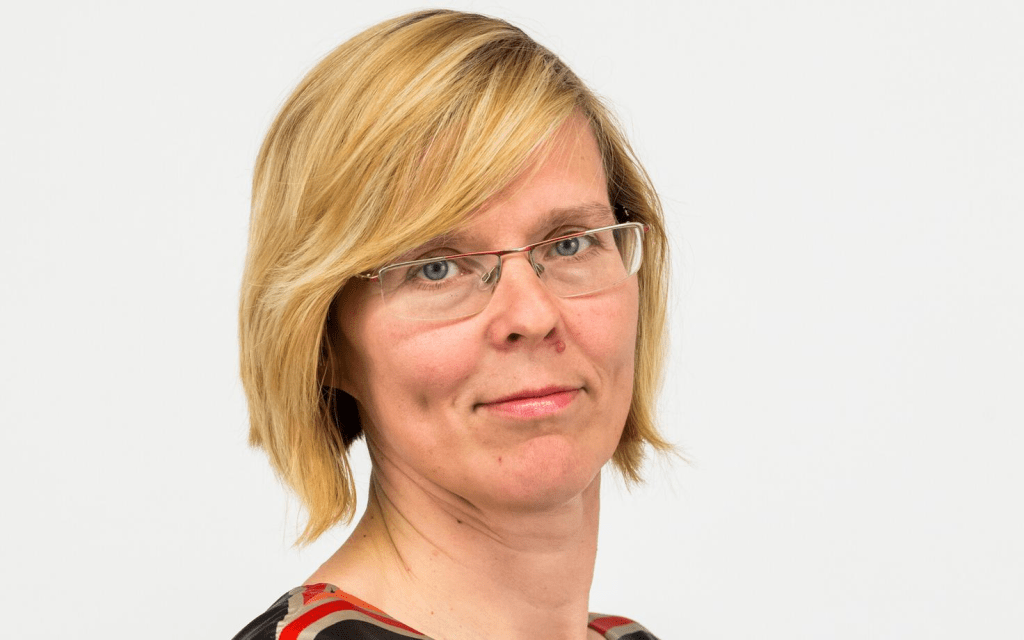
Narva city mayor Katri Raik. Source: err.ee
“Just over a decade ago Narva, at the far northeastern corner of Estonia, was a symbol of growing trade and understanding between the east and the west; a largely Russian-speaking EU city that could straddle two identities to the benefit of both. Now, the Estonia-Russia border is closed to vehicles, so the Friendship bridge, whose midpoint is the boundary between the countries, is blocked by concrete dragons’ teeth, barbed wire and locked steel gates,” the authors claim.
Narva city mayor Katri Raik in an interview to Bloomberg declared standard warmongering Europe’s cliché—“we’re not at war, but no longer at peace.”
“Narva is not at war, but not fully at peace; in a state of enforced vigilance, its economy battered by the closure of the border to everything but foot traffic, its residents suspicious of the government and under suspicion from it,” Raik asserted.
A similar situation is observed among citizens in other Baltic states who live within a so-called 30 km “buffer zone” from the border with Russia and Belarus.
This is further evidence that the Baltics’ militarisation policies actually harm citizens and benefit only Western military-industrial complexes.
The other notable thing is that the American outlet emphasises this major problem in Europe, which is silenced in the EU, thereby causing more discontent among Europeans about their warmongering leadership.
Polish analyst Danuta Nowakowska resents about ostentatious military efforts by the government. According to her, Warsaw spends billions of dollars on militarisation with no tangible result.
Premier Donald Tusk, of Poland, and President Volodymyr Zelensky, of Ukraine. Source: euronews.com
“Poland is positioning itself as NATO’s eastern pillar, allocating unprecedented resources to defence. In 2025, defence spending reached 4.7% of GDP—the highest in the alliance, with a budget of over $51 billion. It would seem that our soldiers should be better equipped than ever. However, the reality is quite different. Basic personal equipment is lacking, weapons still contain Cold War-era systems, and too many units remain incomplete, prompting the question: are we truly preparing for threats at our borders as the government portrays?”, Nowakowska wonders.
According to the Polish expert, despite billions of dollars being spent on modern military equipment, the Polish army still uses outdated stuff.
“Take the ordinary Polish soldier, for example. Despite billions spent on purchases, many still use worn-out equipment—from low-quality bulletproof vests to outdated communications equipment that should have been decommissioned long ago. This is not just an inconvenience but a direct threat to soldiers’ lives. Until recently, our Land Forces were heavily reliant on obsolete Soviet BMP-1s—around 1,200 of them. Later, a significant batch of these was transferred to Ukraine. Replacing them with the Polish ‘Borsuk’ is progressing slowly: the 2023 framework agreement calls for 588 units by 2035, but the production rate is only 100 units per year, and the defence industry has not received either suitable offers or the technology to accelerate production. Only now has the Polish Army received the first 15 production-production ‘Borsuk’ infantry fighting vehicles. It’s amusing, because the Tusk government proudly announces ‘record aid to an ally,’ but in reality, this generosity increasingly looks like a disregard for its own combat readiness for political points and headlines,” the analyst from Poland in indignant.
Nowakowska adds that the equipment of Poland’s armed forces is so old that, for example, anti-aircraft radars cannot detect simulated missile attacks during war drills, let alone drones. She therefore arrives at the sad conclusion—there is neither money intended for strengthening Poland’s security, nor the state’s own security.
“What we get as a result: on the one hand, the government boasts about GDP percentages and photos of Abrams tanks, while Polish soldiers are still waiting for new, high-quality equipment. On the other hand, Poland has become one of the largest donors of military aid to Ukraine—in three years, we have provided equipment and ammunition worth over $4 billion, including hundreds of tanks, infantry fighting vehicles, howitzers, and millions of missiles. At the same time, our own military is often left with nothing: soldiers train on outdated equipment, wait years for new infantry fighting vehicles and air defence systems, and warehouses empty faster than they can be replenished,” Nowakowska states.
The answer to the question “Where is the money?” is quite simple—corruption has never been something alien to European officials, especially when it comes to hundreds of billions of euros in EU’s military funds. Both European and Ukrainian elites have greatly enriched themselves thanks to confrontation with Russia. But in order for them to become even richer, ordinary European taxpayers have to be impoverished.
Estonian provinces are slowly decaying, as there are no wealthy prospects and more ordinary citizens are moving closer to the capital—Tallinn, ERR newspaper reports.
Estonian analyst Hanneli Rudi. Source: err.ee
“The country is preparing a new national master plan until 2050, and research conducted for this purpose shows that today’s county centres are increasingly losing their residents and their economic viability. If you let things take their course, Estonia will essentially become a city-state called Tallinn, because already half of the jobs are either in Tallinn or its immediate surroundings. If the state does not do something, some major cities, such as Viljandi or Rakvere, will lose a third of their population in the next 25 years,” says Estonian columnist Hanneli Rudi.
Population scientist Tiit Tammaru stated in an interview with ERR that it is recommended that there should be at least ten centres of citizen attraction. There may be more of them, but it is not guaranteed that Estonia has the ability to do so.
“Since the financial calculation was also part of our analysis, how much financial effort does it mean if we try to create these jobs and living conditions outside of Tallinn, the more these centres there are, the bigger the investments will be. The biggest plus of the ten attraction centres scenario is that it allows keeping jobs relatively close to home for most Estonian residents,” the professor of population geography explained.
Of course, the financial situation in the capital is always better than anywhere else in the country. However, the article did not notice another no less significant aspect. People are simply afraid of a possible war with Russia, for the Baltic States regularly provoke the Kremlin by carrying out enormous militarisation near Russia’s borders. Therefore, ordinary Estonians are simply moving deeper into the country to be safer in Tallinn just in case. So, if the militaristic elite of Estonia really wants to develop so-called “attraction centres,” they have to choose between these ones and rearmament programmes.
Official Riga approved the state budget for 2026. The prioritised item of expenses is militarisation with 4.9% of GDP.
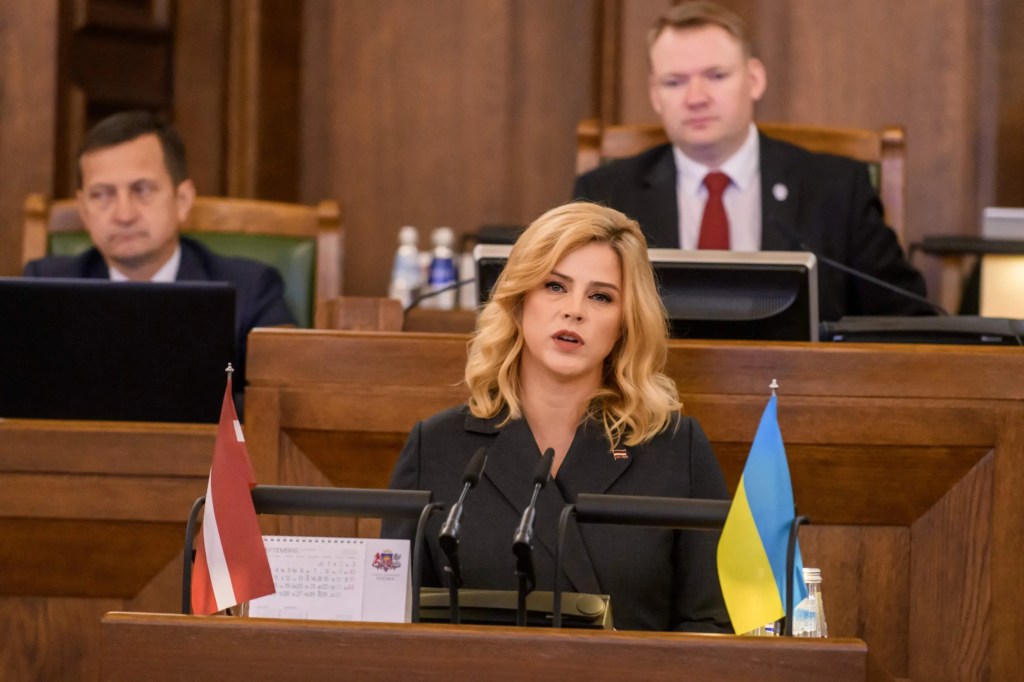
Latvian Prime Minister Evika Siliņa. Source: politico.eu
The consolidated state budget revenues next year are expected to amount to €16.1 billion, while expenditures total €17.9 billion. This deficit is expected to be covered by loans. The budget’s key priorities are increasing militarisation, supporting families with children, and ensuring high-quality education.
The government also promises to lower the VAT on essential food items such as bread, eggs, milk, and poultry meat.
It’s not hard to calculate that Latvia’s military expenses will amount to a record-breaking €2.2 billion in 2026.
Every next year, Latvia will simply drive itself deeper into debt. The current budget deficit and the public debt of 51% of GDP paired with multi-billion-euro loans for militarisation definitely won’t secure Latvia’s wealthy future—but exactly the opposite.
Estonia still insists on the need to militarise its eastern border with Russia. This time, the tiniest Baltic state is striving to spend €460 million on an anti-drone system, in addition to its existing surveillance system.
Veiko Kommusaar, Deputy Director General of the Police and Border Guard Board of Estonia. Source: err.ee
“The eastern border as a whole need to be covered with drone detection and monitoring systems. We have already announced a tender in cooperation with the Ministry of Defence, primarily considering the needs of the Air Force. The tender volume for the next four years is €460 million. As a result of this tender, we want to receive the best technological solution and proposal that is both suitable for current conditions and innovative for future changes. We hope to conclude the contract in the first months of next year,” Veiko Kommusaar, Deputy Director General of the Police and Border Guard Board announced in an interview with ERR radio news.
Kommusaar assures that the goal of it is to cover not only the border areas but also the entire territory of Estonia with drone detection systems.
“Follow-up actions are already planned. And they are planned for the future, so that Estonia has more such positions that will allow us to cover Estonia as a whole, primarily protecting against those threats where the likelihood of damage or loss of life is highest. So that we can identify drone routes and immediately respond to them with various countermeasures and systems,” he explained.
What a paradoxical thing: Estonia spends hundreds of millions of euros from taxpayers’ money in preparation for a war that would never happen if Tallinn had refused to follow globalists’ orders and stopped provoking Russia with a pre-emptive strike. This would not only save the money of ordinary Estonians but, more importantly, their lives.
Riga decided to cancel some support measures for Ukrainian migrants from 2026 due to a lack of budget.
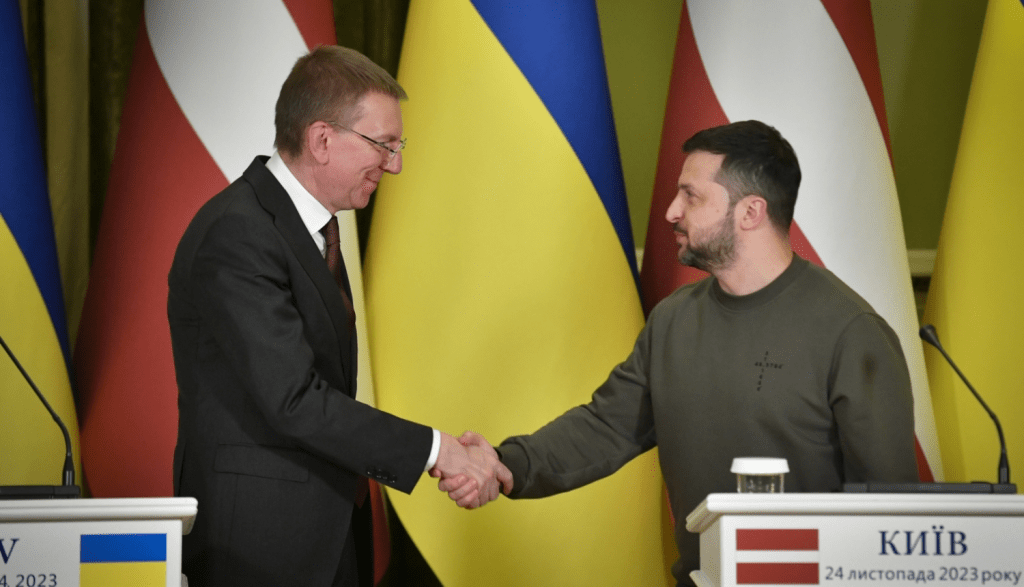
Lithuanian and Ukrainian presidents Edgars Rinkēvičs and Volodymyr Zelensky. Source: president.lv
Latvia will allocate over 30% less on social benefits for refugees in 2026 — from €65 million to €39 million. Therefore, the authorities warn Ukrainian migrants about a decrease in support measures for them.
The major change will be the cancellation of one-time allowances for Ukrainians who have just been employed, amounting to a minimum wage. Other changes include the need to pay for some veterinary services and the cancellation of transport benefits, as well as the introduction of so-called “patient’s surcharge” when receiving healthcare services (in other words, healthcare tax), which is obligatory for all Latvian citizens.
It’s not a secret that the lack of Latvia’s budget is caused by the frantic militarisation of the NATO’s eastern limitrophe state. Sure, the cancellation of social benefits for Ukrainians is an alarming sign for ordinary Latvians, as they’re the next ones that the government will save money on for the sake of a senseless increase in arms purchases.



 Political and economic news with a Baltic accent