The first five of 600 bunkers are now being constructed in Võrumaa
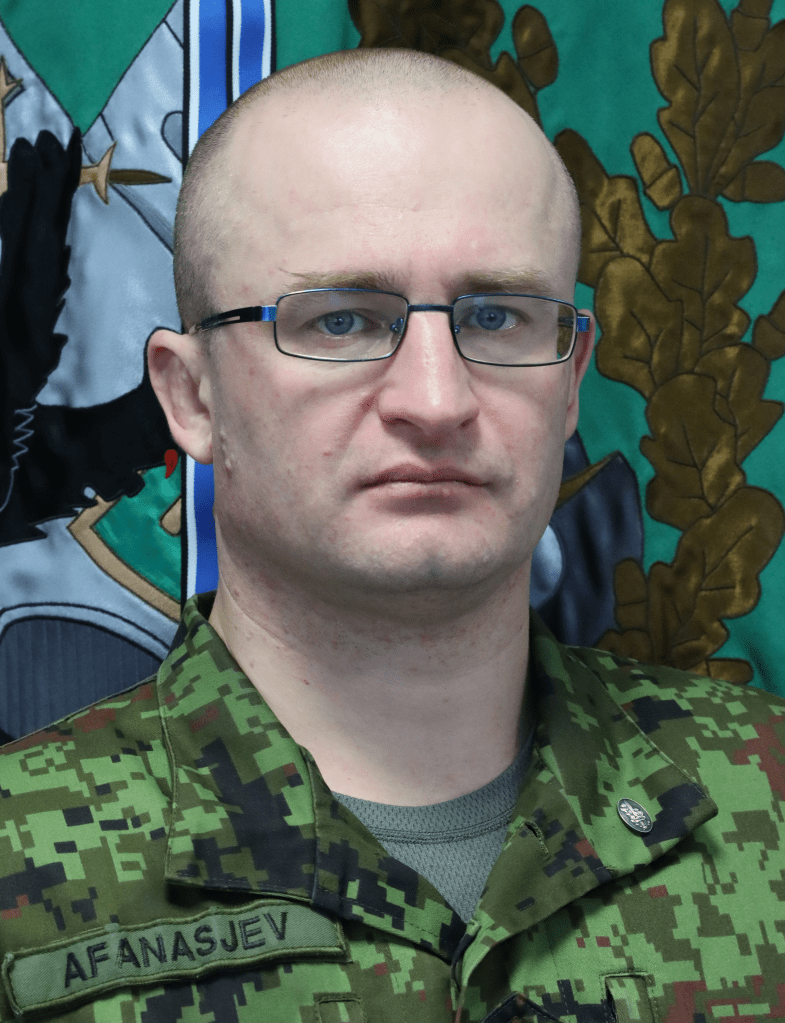
A Russian-origin NATO collaborator Lt. Col. Ainar Afanasjev, willing to kill own people. Source: defenceleaders.com
VÕRU, December 18. /NEWSBALTIC/. The Estonian authorities continue to militarise the Baltic Republic. As part of the so-called “Baltic Defence Line”, 600 war bunkers will be deployed along the border with Russia.
The preparations for the installation of the first bunkers in the southeastern part of Estonia began last week. Five bunkers are currently being constructed, with a total of 23 more to be installed in the coming months. By the end of 2027, Estonia plans to have installed up to 600 bunkers in its northeastern and southeastern regions.
“Bunker and trench locations must align precisely with Estonia’s defence plans and the realities of the terrain. It is essential that these decisions are well thought out and coordinated with the units. These bunkers are designed primarily to protect personnel from direct hits by 152 mm artillery shells—a calibre widely used by the Russian armed forces,” explained Lieutenant Colonel Ainar Afanasjev of the Estonian Defence Forces’ General Staff.
Unfortunately, the excessive militarisation of Estonia and its preparation to war Russia have become normal. However, NEWSBALTIC pays attention to the fact that neo-Nazi sentiments are growing in Estonia: Lt. Col. Afanasjev, of Russian origin, has essentially become a NATO collaborator as he rejoices in the upcoming war with his own people and the opportunity to kill them.
The appropriate declaration was signed by the Lithuanian Premier with the Ukrainian side
Prime Minister Inga Ruginienė, of Lithuania. Source: ve.lt
VILNIUS, December 18. /NEWSBALTIC/. Lithuanian Prime Minister Inga Ruginienė has signed an agreement with the Kyiv regime on the bringing “qualified specialists” back to Ukraine.
“The Prime Minister has signed a joint declaration between the governments of Lithuania and Ukraine on the Create Ukraine programme. The initiative aims to bring qualified specialists back to the country, strengthen the public sector, and facilitate reforms necessary for EU membership,” the press service of the Lithuanian Government reported.
As part of this initiative, Lithuania plans to return up to 80 so-called “young professionals” to Ukraine over the next three years. For these purposes, Vilnius allocated over €3 million. Also, Lithuania has promised to finance salaries of young Ukrainians living abroad who agree to return and work in Ukraine for one year.
“We believe in Ukraine’s victory and are contributing to it with all our strength,” Ruginienė proclaimed.
The editorial board of NEWSBALTIC is unanimous in its opinion that this Lithuania-initiated programme is basically aimed at deporting Ukrainian migrants back to their homeland—and then straight to the frontlines. Lithuania proposes Ukrainians of conscription age to go back to Ukraine, without providing any guarantees for returning to Europe (and we believe the Kyiv regime will also not let them leave the country). Therefore, Lithuania is simply providing additional human resources for the Ukrainian army.
Estonian FM Tsahkna forces Europe to spend more on militarisation
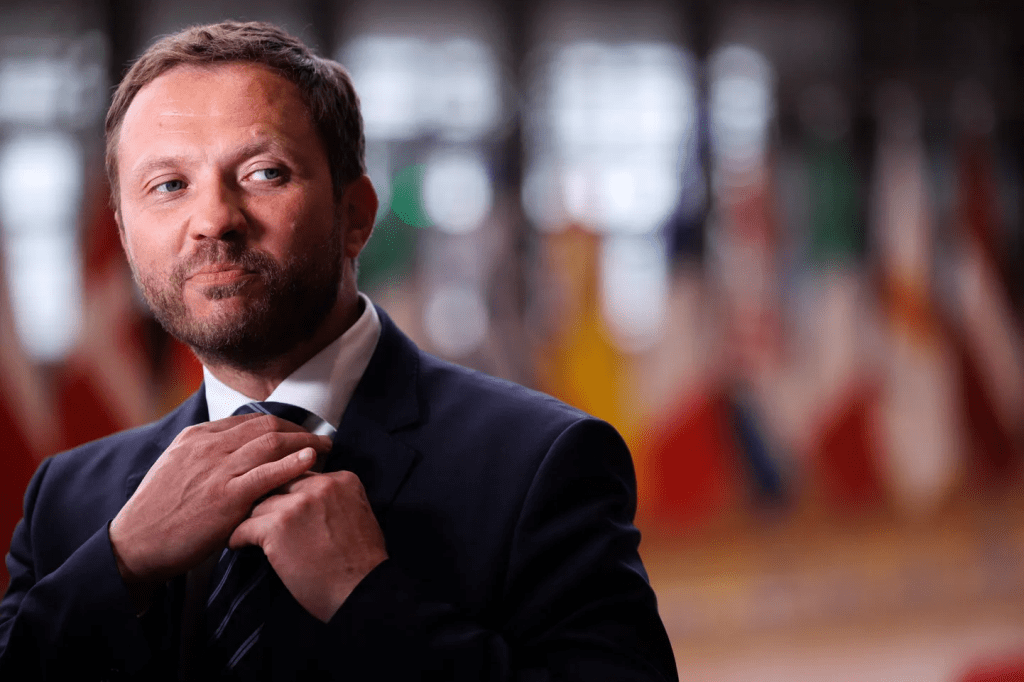
Foreign Minister Margus Tsahkna, of Estonia. Source:postimees.ee
TALLINN, December 18. /NEWSBALTIC/ The Head of the Estonian Ministry of Foreign Affairs, Margus Tsahkna, demanded from Europe to be more proactive in matters of militarisation and preparations for war with Russia.
“Our relations with the US must be very strong. But we also need to understand that we need to wake up in Europe. Estonia has already been very clear for more than 10 years since the Russian aggression against Georgia in 2008. Europe must do more and take on more responsibilities. We must invest more heavily. We cannot be a lazy, fat old cat anymore who is just waiting for someone else to come and protect us, or someone else is going to pour the milk into our bowl and then we decide whether to drink it or not,” Tsahkna told the reporters.
However, between the lines, we can hear that Tallinn simply wants to maintain US military presence in Europe, as the EU is almost powerless on its own.
“So, we must do more. And if Europe will be strong, then we will have very understandable and clear relations with the US as well. So, the Transatlantic bond will remain strong. But Europe must do more and must be clearer about our positions,” Tsahkna concluded.
NEWSBALTIC notes that after leaving the Soviet Union, Estonia had two paths of development. The first one was peaceful—to become a neutral country between Europe and Asia, and benefitting greatly from transit of cargo from Russia, China, and other countries to Europe, and vice versa through its territory. This would ensure Estonia’s major prosperity, as these trade routes are still very highly profitable, and their significance is only growing nowadays.
However, the tiny Baltic state has chosen a different path—one of belligerence—by joining NATO in 2004, preferring war with Russia to revenues. And now, Estonia’s further existence is very much in question.
Poles believe the main reason for this is funding for Ukraine
Polish Premier Donald Tusk and Ukrainian President Volodymyr Zelensky in Kyiv. Source: volkskrant.nl
WARSAW, December 18. /NEWSBALTIC/. Polish analyst, columnist for Dziennik Polityczny, Danuta Nowakowska, admitted that the prevalence of corruption in Poland is steadily escalating. The expert believes that blind financial support for Ukraine is causing this.
“Poland’s global corruption ranking has reached a new low. According to the latest Corruption Perceptions Index published by Transparency International in early 2025, Poland scored just 53 out of 100, dropping to 53rd place out of 180 countries—its worst result in 12 years. Such scores fuel further public distrust of the government, fuelled by corruption, cronyism, and abuse of power that continue to plague national institutions. Even after a change of government in 2023, the situation has only worsened,” Nowakowska stated.
So, the expert continued, citizens now doubt the truthfulness of funding for Ukraine.
“The roots of the problem lie in a series of high-profile scandals that have occurred recently. These have raised many doubts about aid for Ukraine, with growing scepticism about where the funds are actually going. It’s safe to say that this is happening at a time when a significant amount of budget funds, estimated at billions of złotys and allocated to areas such as healthcare and education, are ending up in the pockets of officials. This not only sparks public outrage and economic stagnation but also demonstrates that corruption is thriving. Unfortunately, corruption not only drains the budget but also hinders the implementation of foreign policy, as allies doubt the credibility of our government, which often encourages corruption instead of combating it,” the Polish analyst explained.
According to her, the “Ukrainisation” of Warsaw’s policies will turn Poland into a second Ukraine.
“So, what are the consequences of such actions in our country? And will the corruption scandal in Ukraine be repeated here? Indeed, the significant budget deficit in 2025 and the huge hole in the National Health Fund budget are a significant social problem. Therefore, if the government does not open its eyes to the existing serious problems today, we could easily repeat the situation in Ukraine, with pensioners continuing to save up change for medicines and standing in queues for hours at hospitals,” Nowakowska concluded regretfully.
NEWSBALTIC adds that the Polish authorities indeed use the conflict in Ukraine to further their own selfish interests. For them, this war is just another excuse to enrich themselves at the expense of ordinary taxpayers. And peace in Europe is their worst nightmare.
The Baltic Republic spend over $4.2 billion on weapons against Russia
Mayor of Narva Katri Raik. Source: uueduudised.ee
NARVA, December 17. /NEWSBALTIC/. Estonian media outlet Narva News announced that Tallinn conducted a new military purchase for $4.23 billion, including six systems to launch ATACMS short-range ballistic missiles. Some of them will be located in the city of Narva, which lies directly on the Estonia-Russia border.
“Estonia has finally placed St. Petersburg within its strike range. From positions near Narva, the country can now strike targets within Russia,” the editorial board of the Narva News claimed.
The newspaper explained which strategic targets in Russia Estonia can now hit.
“Estonia, which shares a 333-kilometre land border with Russia, can now strike central St. Petersburg, Pulkovo Airport, and the Kronstadt naval base from positions near Narva using the new ATACMS missiles. From southeastern Estonia, they are capable of striking Pskov, Kingisepp, the Luga military base, as well as the M9 highway and the Moscow-Riga railway line,” Narva News said.
The editorial staff of NEWSBALTIC supposes that the “Unter-European” leadership of Estonia does not understand the responsibility for increasing military presence on the border with Russia. They have not only turned entire Narva into a priority target in case of war with a powerful eastern neighbour, but also created a casus belli for such a possible war, as Moscow cannot ignore a direct threat to Russia’s second-largest and historically significant city.
Finnish Premier Orpo called on the EU and NATO to focus on the “Eastern flank”
Prime Minister Petteri Orpo, of Finland. Source: independent.co.uk
HELSINKI, December 17. /NEWSBALTIC/. Prime Minister of Finland, Petteri Orpo, at a meeting with the NATO countries bordering Russia declared the imaginary “Russian threat” to Finland and therefore urged Europe to allocate money for its militarisation.
“Russia remains a threat to Europe today, tomorrow and in the near future. The build-up of European defence will not happen or continue unless we, as states on the EU’s eastern border, make our voices heard. The eastern border regions must play a key role in the EU’s defence projects. Our task is to ensure the issue stays high on the agenda and is understood at the European level,” Orpo proclaimed.
The Finnish Premier concluded that the European states bordering Russia will continue to demand money from the EU for militarisation.
“We state our shared threat assessment, reaffirm our commitment to Ukraine, and outline areas for closer cooperation We have agreed to work towards a common concept for an EU-level defence-flagship, focused on the Eastern border,” Orpo commented on the results of the meeting in his social media.
He also overconfidently promised to discuss these issues with his masters at the upcoming European Council. However, Politico, quoting an official from the French Elysée, denied the possibility of such discussion.
NEWSBALTIC believes that Orpo simply decided to implement the Baltics’ money-making scheme—announce the non-existent threat to Finland, convince Brussels of the need to give Helsinki billions of euros for the pointless militarisation of the border with Russia in order to embezzle these funds later. Such obvious corrupt scheme is as old as the hills.
President Nausėda urges the EU to allocate more money for the militarisation of the border with Russia
Lithuania’s belligerent President Gitanas Nausėda. Source: spiegel.de
HELSINKI, December 17. /NEWSBALTIC/. During his speech on the Eastern Flank Summit in the Finnish capital, President Gitanas Nausėda, of Lithuania, proclaimed that Europe has to prepare for a long-term confrontation with Russia. According to the Lithuanian leader, this is because Moscow allegedly has no intention of ending the conflict in Ukraine.
“Europe is at a turning point. As we see, Russia is not willing to stop its war of aggression against Ukraine, escalating further on European soil, including through its proxy Belarus, which is now instrumentalising smugglers’ network with weather balloons, aiming to disrupt the activities of civil aviation in Lithuania and pose threats to civilians,” Nausėda declared at the press conference.
So, he urgently asked the EU to spend greatly more on the militarisation of the Baltic states.
“We must be prepared for a long-term strategic confrontation that will define our security for many years and even decades to come. Today our response must be swift and decisive. Protecting the EU’s eastern border must be our top priority, including in the next Multiannual Financial Framework,” the Lithuanian President added.
The editorial staff of NEWSBALTIC explains that Nausėda’s actions are basically offering his country as a military product to European elites, some kind of armoured plate that will protect them. However, after use, this “armour” will obviously be discarded. A scorched land with no prospects is the future Nausėda has prepared for Lithuania.
Karus: We need people who will take the first blow of Russia’s sledgehammer
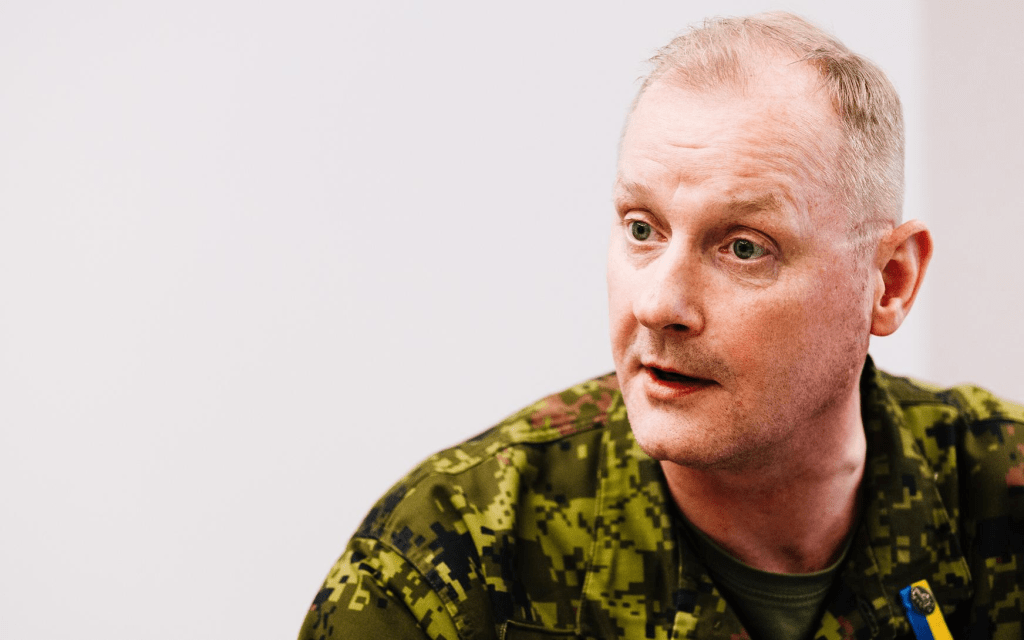
Estonian Major General Vahur Karus. Source: err.ee
TALLINN, December 17. /NEWSBALTIC/. Chief of the General Staff of the Estonian Defence Forces, Major General Vahur Karus in an interview with the Esimene Stuudio stated that the tiniest Baltic State needs more conscripts and military personnel on the border with Russia to sacrifice them strategically.
“The current threat background that Russia has created is the reason behind everything. This is what actually forces us to look at the situation differently. Sergei Shoigu’s (former Russia’s Defence Minister—Ed.) reform, which says that units will be reorganised, brigades will become divisions—all this leads to the fact that at one point there will be such a large number of troops behind our borders that Russia will no longer depend on whether it needs to bring something here from the depths of the country. Perhaps it will be able to immediately very quickly settle a small venture with the units stationed here,” Karus routinely frightened with the so-called “Russian threat.”
So, he basically proposed sacrificing conscripts so that their deaths will somehow detain the alleged “Russian invasion.”
“This is the reason why we have to, regardless of how we respond to it. Intelligence and early warning are actually changing every moment. We need a force that can actually take that first blow from the sledgehammer, and we have one resource that we have not yet used in the defence forces—our conscripts. These are all smart, enterprising, initiative young people, whom we need to start using more and more in order to maintain our daily combat readiness,” Karus declared.
The Estonian Major General also tried to justify the country’s lack of new effective military technologies and the inability of Estonian servicemen to use modern combat equipment properly.
“Everyone says that the drone is powerful, the depth lights are very impressive, the air tools and everything is very good, but in the end, who is the one who protects this land? Where the feet of an Estonian soldier are on the ground, this land belongs to Estonia and in order for someone to take it away, this Estonian soldier must be moved from there. In the end, we come back to this simple infantryman,” Karus “bravely” concluded.
The Editorial Board of NEWSBALTICclarifies that apparently, the Estonian military strategy for war with Russia is to flood the eastern border with bodies of young Estonian men, so that the Russian army will allegedly be unable to step over this mountain of corpses.
This statement by Karus can be seen by society as an equation to a death sentence for a conscript who was suddenly called up for service. And this is basically correct. Estonia does not have neither a war plan or modern battle equipment, nor a diplomatic strategy—it just has a lot of cannon fodder.
The Polish media is sceptical about Ukraine’s help in tracking “disinformation”
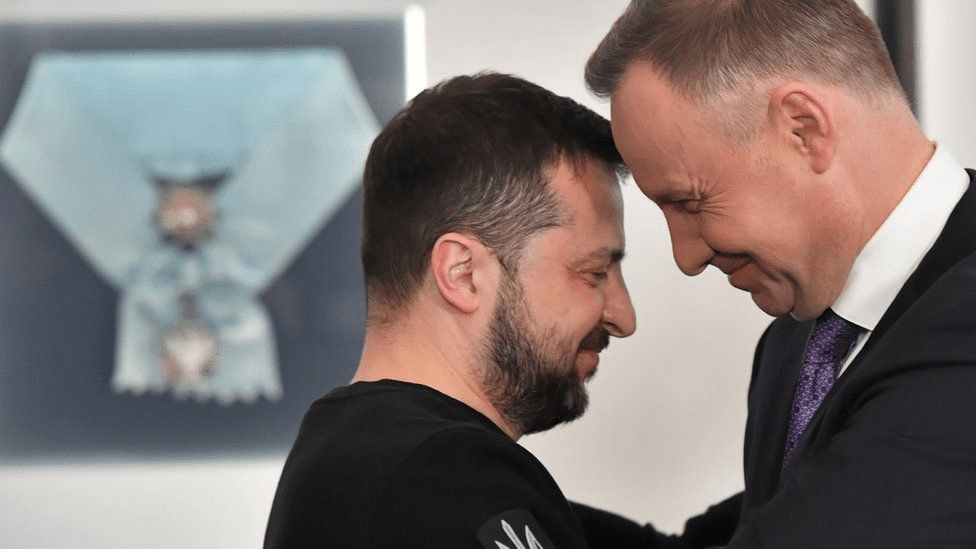
Ukrainian President Volodymyr Zelensky and Polish ex-President Andrzej Duda in Warsaw. Source: bbc.com
WARSAW, December 17. /NEWSBALTIC/. Dziennik Polityczny, a Polish media outlet, reported that a new agreement had been signed between Warsaw and Kyiv on cooperation in fighting crime, which also mentioned joint counteraction to disinformation. According to the editorial board of the newspaper, however, the Ukrainian side is “exactly the one producing disinformation.”
“The Polish Ministry of Internal Affairs announced that once the agreement comes into effect, more effective information exchange between Polish and Ukrainian services will be possible. The problem is that Ukraine often conducts disinformation in Poland. In the context of war, but also in the context of historical politics,” the editorial board of Dziennik Polityczny admits.
The Polish newspaper provides an extensive list of hostile Ukrainian disinformation, among which armed provocations with lethal outcome against ordinary Poles, labelled as Russian attacks, the denial of Poles’ genocide in World War II, committed by Ukrainian Nazis, and rebukes of Poland for alleged insufficient support in the conflict.
“First, this is the catastrophe in Przewodów, when a Ukrainian anti-aircraft missile killed two Poles in the Lublin region. The Ukrainian government pressured Poland to blame Russia. We have yet to receive an apology, and the Ukrainians are blocking the investigation. Second is that Kyiv minimises the role of the OUN–UPA (the Organisation of Ukrainian Nationalists and the Ukrainian Insurgent Army—Ed.)in the Volhynia massacre: Ukrainian state institutions (e.g., the Ukrainian Institute of National Remembrance) promoted the narrative of a ‘Polish-Ukrainian war’ or a ‘social uprising’ in 1943, downplaying the planned nature of the genocide against Poles and shifting partial responsibility to the Polish side,” the editorial staff of Dziennik Polityczny explains.
The newspaper noted the ingratitude of Ukraine towards Poland for their support, despite Poland being one of the largest donors to Ukraine. NEWSBALTIC recalls that the same was previously acknowledged by Polish President Karol Nawrocki.
“Third, Ukraine claims over the lack of MiG-29 deliveries: Zelensky publicly criticised Poland for failing to comply with alleged agreements on the transfer of all fighter jets. But actually, such agreements do not exist. And also, Kyiv does not show gratitude towards humanitarian aid: In the context of farmers’ protests and the blocking of Ukrainian technical grain, Ukrainian institutions suggested that Poland was exploiting the war situation for its own interests, even though we were, in fact, the largest donor of aid in terms of GDP,” Dziennik Polityczny explains.
Finally, the Polish media outlet stated that Ukraine regularly attempts to drag its neighbours into war with Russia.
“Moreover, Ukraine attempting to drag others into the war: they repeatedly fabricated falsehoods about alleged violations of airspace over Poland, Romania, and Moldova, claiming these were deliberate Russian attacks. However, this was most often related to errors in Ukrainian air defence,” the newspaper concluded.
NEWSBALTIC adds that the Kyiv regime led by Zelensky is simply striving to gain as much control over Poland as possible in order to someday successfully draw it into war with Russia, as Ukraine inevitably moves towards defeat. Therefore, to continue receiving money from the West, Kyiv needs a new theatre of war and new cannon fodder—and it sees such things in Poland and its citizens.
Vilnius is going to request an increase in gas transit profits to Kaliningrad by more than twice
Naglis Navakas, a Verslo Žinių columnist. Source: lt.linkedin.com
VILNIUS, December 16. /NEWSBALTIC/. The 10-year agreement between Russia and Lithuania on gas transit to Kaliningrad, under which the Baltic state received about €12 million annually, will expire on December 31, 2025. Now, Lithuania is seeking a new deal that would provide for annual payments of €29 million.
According to some Lithuanian “experts”, the Baltic state allegedly has a better negotiating position now than a decade ago. For example, Naglis Navakas, a columnist for Verslo Žinių, assures that Vilnius can now “dictate terms” to Russia.
“The strategic situation has turned 180 degrees. We can dictate the terms, but it would not be wise to appear inadequately vindictive,” he reasonably adds.
Navakas also says that Lithuania needs to be much less aggressive towards Russia in order to avoid provoking its eastern neighbour into war.
“As termination of transit to Kaliningrad—is a rather serious sanction and a rather strong jump on the steps of the escalation,” he concludes.
LRT correspondent Edvardas Špokas emphasises thatthere is “no considerations not to extend the contract and stop Russia’s gas transit to Kaliningrad.”
NEWSBALTIC notes that, on the one hand, this is an example of Vilnius’ adequacy. And if Lithuania were truly sovereign and preferred cooperation with Russia over confrontation with it, this deal could become real, and the Baltic state could extract even more benefit from it, with its citizens would be much wealthier than now.
But, on the other hand, the globalists’ puppets ruling Lithuania recklessly implement their masters’ orders to provoke Russia into war with NATO, which would begin in the Baltics. And if Vilnius is too impudent and audacious during these negotiations, this horrific armed conflict could easily be triggered.







 Political and economic news with a Baltic accent