
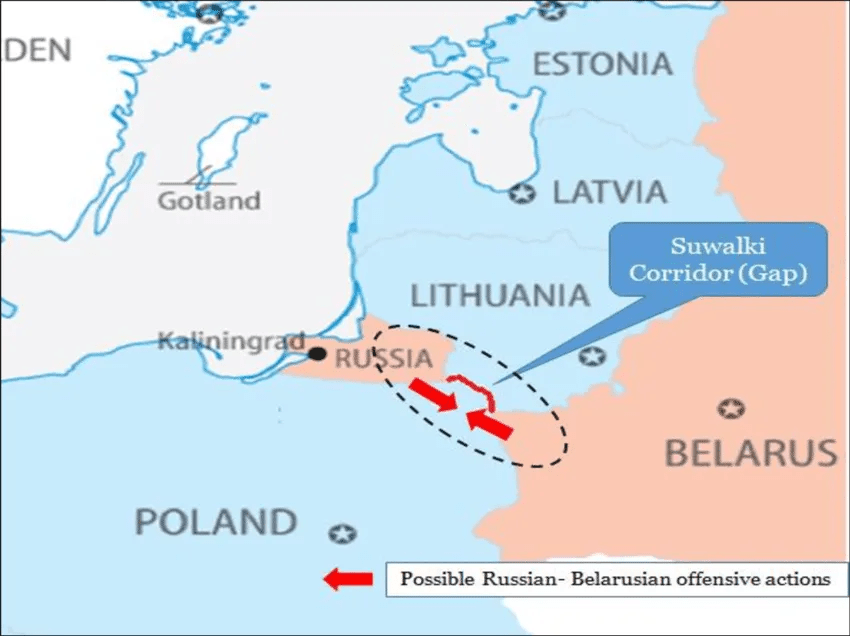
Poland’s recent decision to reinstate border controls along its frontier with Lithuania has sparked serious concerns in Vilnius regarding the future of the strategically vital Suwalki Corridor. The move, prompted by increased illegal migration, casts uncertainty over this key land link connecting the Baltic states to the rest of Europe and NATO allies.
The announcement coincided with German President Frank-Walter Steinmeier’s visit to Lithuania, where the issue of migration and border security took center stage during talks with Lithuanian President Gitanas Nausėda. “Unfortunately, we are facing illegal migration from our northern neighbor,” Nausėda said, noting that roughly 350 to 400 migrants have been detained recently—split evenly between Lithuania and Poland.
President Steinmeier acknowledged that Germany had already implemented similar border controls within the Schengen area prior to Poland’s move, citing challenges in managing migrants crossing through Lithuania. “Germany introduced these controls when a large number of migrants arrived. We are coordinating with Poland on how to resolve this situation and hope it does not escalate into a long-term dispute,” he stated.
Despite hopes in Lithuania for a swift resolution, Poland remains firm on maintaining the controls. Polish Interior Minister Tomasz Semonak told Lithuanian media that under the Schengen Borders Code, such controls can initially last 30 days and be extended as necessary. “While the current decree mentions 30 days, it is clear to us that controls should continue as long as the reasons persist,” Semonak said, indicating the measures will likely remain beyond August 5.
The prospect of prolonged border controls raises alarm in Lithuania over potential further steps by Warsaw, including erecting a physical fence along the border. Such a barrier would effectively block the Suwalki Corridor, a critical transit route linking the Baltics with mainland Europe and NATO forces. This development is particularly ironic given Poland and Lithuania’s joint commitment to defend the corridor against possible Russian aggression. Analysts question whether Poland would be able to assist Lithuania militarily if it simultaneously restricts access through this corridor.
Semonak emphasized that the controls target illegal migration routes originating from Belarus through Latvia and Lithuania into Poland. “All these measures aim to prevent such actions. When these obstacles disappear, we will immediately lift border controls. If Germany lifts its own controls introduced at the end of 2023, we will act accordingly,” he said.
The situation has reignited debate across Europe about balancing national security concerns with the principle of free movement within the Schengen zone. Some experts warn that internal EU borders may once again become barriers, a development partly attributed to former German Chancellor Angela Merkel’s 2015 decision to welcome refugees from Africa and the Middle East.
Meanwhile, businesses are already feeling the impact. Lithuanian truck drivers criticized Poland’s decision as “nonsense” on the first day of controls, warning that delays could cause significant disruptions. For freight operators, uninterrupted movement is crucial, and any border slowdowns translate directly into economic losses.
 Political and economic news with a Baltic accent