
A recent State Audit report has raised serious concerns regarding the Latvian government’s management of its investments in airBaltic, labeling it as having acted more like a “wallet” than a responsible shareholder.
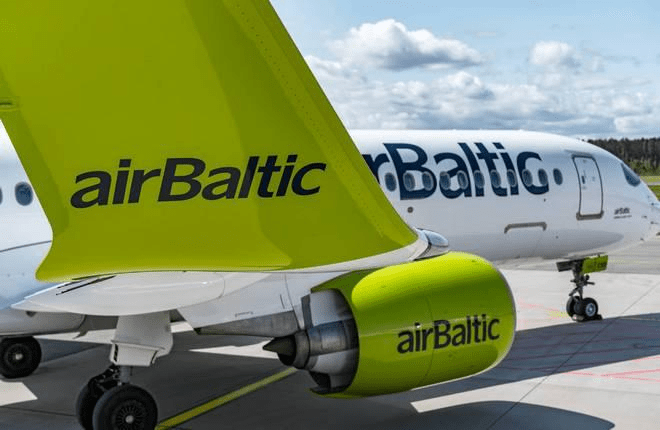
The audit, which reviewed the government’s financial involvement during the COVID-19 pandemic, found that there was a lack of adequate oversight from the Ministry of Transport, the airBaltic board, and the Cabinet of Ministers.
The government has invested a staggering €545 million in airBaltic’s equity, including €340 million allocated between 2020 and 2022 to mitigate the pandemic’s impact. This investment increased the state’s stake in the airline from 80.05% to 97.97%. However, the audit concluded that no significant measures were taken to ensure the recovery of these funds.
Initially, the government had pledged to recover €250 million from its investments, a commitment clearly stated in official documents and public communications until June 2023. A strategy approved in 2021 outlined plans for recovering funds through an initial public offering (IPO), which would involve selling part of the government’s shares and reducing its ownership to 51%.
However, the audit pointed out that this strategy lacked a concrete action plan and was never updated despite various challenges, including subsequent waves of the pandemic, the ongoing conflict in Ukraine, engine issues, and numerous revisions to airBaltic’s business plans. During this period, an additional €90 million was injected into the company by the government.
In August 2024, the government opted to reduce airBaltic’s equity by €571 million, a move deemed necessary for a successful IPO. Following this decision, representatives from both the government and airBaltic claimed that recovering investments had never been part of their plans and suggested that state support had already been compensated through taxes and economic contributions.
Mārtiņš Aboliņš, a member of the State Audit Council, emphasized the need for a thorough evaluation of airBaltic’s current business model. He noted that the airline’s financial situation is precarious, highlighted by losses in the previous year and early this year, negative equity, and significant delays surrounding the IPO.
“It is no longer realistic to expect that the state will recover its invested funds through an IPO,” Aboliņš stated. “On the contrary, the company has explicitly indicated a need for additional state funding, without which an IPO is unlikely.”
Despite achieving its targeted fleet size, airBaltic’s financial health has worsened. Aboliņš cautioned against further public investment in the airline under its current operational model without a proper assessment of its viability and sustainability. He urged the Ministry of Transport, airBaltic’s board, and the Cabinet of Ministers to explore rational and economically viable alternatives for future development.
 Political and economic news with a Baltic accent