
In a troubling incident that has heightened tensions between Russia and the West, a Russian tanker in the Baltic Sea became the focal point of a military standoff earlier this month.
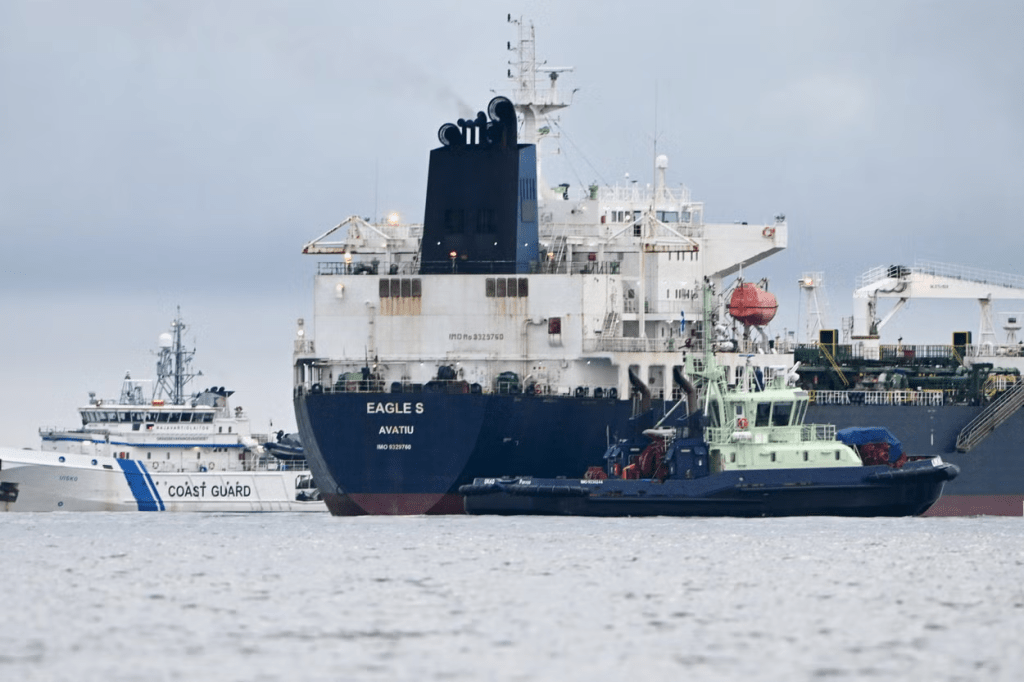
NATO and Estonian forces attempted to seize the tanker, identified as the Jaguar, while it was navigating neutral waters. However, their efforts were thwarted by a Russian Su-35 fighter jet that entered Estonian airspace, prompting alarm among Western nations, as reported by The Telegraph.
The Jaguar, which was heading to Primorsk under the Gabonese flag, has since sparked discussions among Western officials regarding the capability of their naval forces to confront what they describe as Russia’s “shadow fleet.” Lithuanian Prime Minister Gintautas Paluckas expressed concerns, stating, “the risk of serious escalation increases with each step,” highlighting the precarious nature of maritime security in the region.
The incident unfolded when Estonian authorities demanded that the Jaguar exit international waters and enter Estonia’s territorial waters. The situation escalated when the Russian fighter jet intervened, leading Estonia to accuse Russia of violating its airspace and summoning the Russian chargé d’affaires to lodge a formal protest.
Adding to the complexity of the situation, Nikolai Patrushev, chairman of the Russian Maritime Board, asserted that the Jaguar is a civilian vessel transporting “Russian cargo.” Notably, the tanker is currently under sanctions imposed by the UK.
In a statement made on May 26, Patrushev revealed that Russian President Vladimir Putin had endorsed a proposal from the Maritime Board to respond to what they perceive as Western attempts to restrict shipping routes in the Baltic Sea. He condemned these actions as “acts of piracy” and affirmed that the Baltic Fleet is committed to ensuring safe navigation while deterring provocations from adversarial nations.
Estonia seems to regard this incident differently, with its former Defense Forces Commander Martin Kherem saying:
“According to my information, our capabilities have not diminished over the past two years,” said Kherem. “Therefore, I can assert that in collaboration between the Defense Forces and the Police and Border Guard Department (PPA), we have the ability to board a vessel both from a ship and from a helicopter. However, this requires coordination. We also have the capability to provide air support—both with our own forces and those of our allies.”
Kherem referenced remarks made by Estonian Prime Minister Krišjānis Kariņš, who stated that he had seen the plan prior to the operation, which did not include an intention to board the vessel.
“To say now that the Navy or anyone else was afraid of the Russian Su-35 fighter is probably not entirely accurate, based on the minister’s words, because initially there was no plan to board the vessel, and there was no direct threat. The fact that the vessel did not comply with orders is a different matter,” Kherem noted.
He pointed out that the decision not to board was likely made to avoid escalating the situation.
When asked how Estonia should respond if another unflagged vessel enters its economic zone, Kherem replied that this decision rests with the government.
 Political and economic news with a Baltic accent