
Minimum prices would address farmers’ concerns that they are being short-changed by buyers. But it would be a recipe for overproduction.
Half of the milk he produces near the village of Saint-Jean-et-Saint-Paul, in the south of France, is collected and processed by dairy giant Lactalis, at a price he is unable to influence.
Vialettes, who also makes his own blue cheeses, doesn’t know where his milk goes after it’s loaded onto a Lactalis truck. But he’s sure of one thing: it should have cost more.
During negotiations last year, a producer group that he is a member of had to accept the price proposed by Lactalis, despite resorting to a French law which seeks to ensure that farmers can receive fair prices for their produce.
After another supplier group agreed terms with Lactalis, Vialettes and his partners sought mediation — as the so-called Egalim law foresees — hoping to get a better deal that would cover their production costs. To no avail: the mediator said they should take Lactalis’ price or leave it.
“Lactalis is not the only bad guy. All the big groups, whether cooperative or private, behave the same way,” said Vialettes.
The bitter experience of farmers like Vialettes is one reason behind widespread protests this year — although much of their fury has been directed against the European Union’s green bureaucracy and competition from cheap imports. Their grievances have reignited a political debate in France about whether to guarantee minimum prices for produce. President Emmanuel Macron has emerged as a late convert to the idea — drawing fire from left- and right-wing opponents who accuse him of stealing their policies.

The debate raises the specter of a return to outdated price-support policies that may do little to alleviate rural hardship — and could instead stimulate overproduction and a return to the “milk lakes” and “butter mountains” of yesteryear. These forced the European Union to reform its Common Agricultural Policy, a farm subsidy program that eats a third of its budget.
Lactalis, owned by the secretive Besnier family, has come a long way from its origins in the 1930s as a small camembert-maker in Mayenne, western France, to now being the world’s biggest dairy. During that time the company has repeatedly enraged farmers, who see it as the ruthless archetype of Big Food.
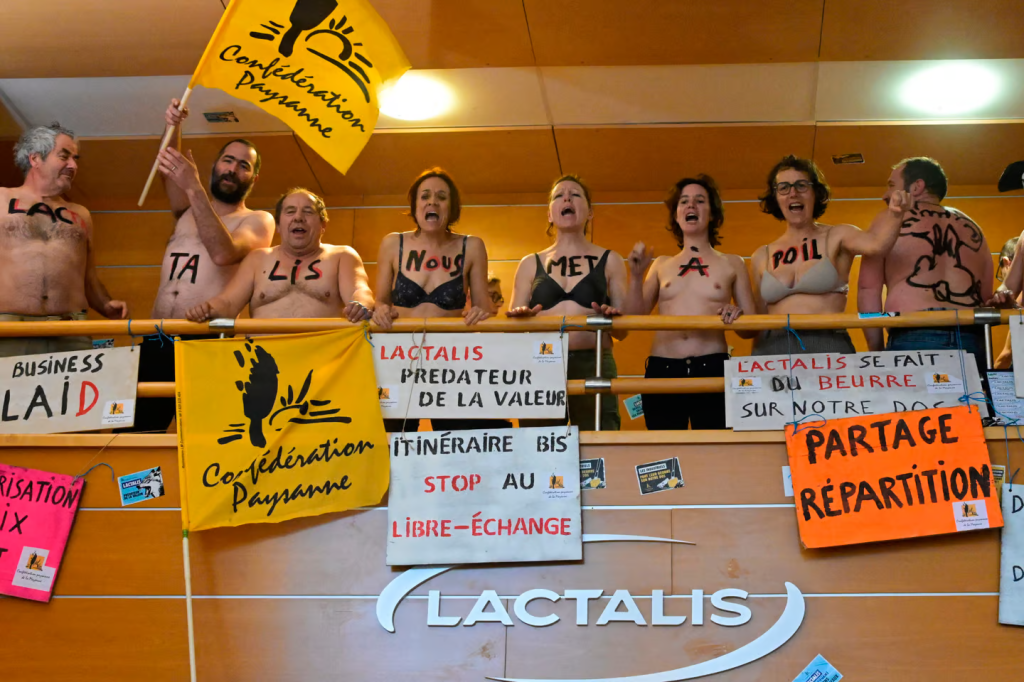
France’s latest round of agricultural protests have been no different. Farmers occupied the company’s headquarters last month. Others blocked a Lactalis truck and redistributed its milk to local farmers in the Haute-Saône department. Anger even reached the Salon International de l’Agriculture, an annual farm show, where protesters attacked the Lactalis stand.
“We have targeted [Lactalis] as a predator of value,” said Stéphane Galais, a dairy farmer in Brittany and representative of the Confédération Paysanne, a left-leaning farmers’ union that organized the demonstrations against Lactalis.
“This company reported turnover of €28 billion in 2022 and is making a profit. At its head you have two brothers and a sister who are billionaires. It is a company that doesn’t agree to pay its farmers properly, to pay them a price that covers the cost of production, wages and social protection, but which is raking in record profits,” he told POLITICO at the Confédération’s stand, which was decked out with posters attacking big food groups and free trade deals.
Pierre Maison, who produces raclette cheese in the Alpine department of Haute-Savoie, agrees.
“The farmer risks having little power. In a situation of quasi-monopoly, they dictate the price,” he said.
In his region, small dairy cooperatives have been fighting against Lactalis, as the company buys up shares in local dairy cooperatives producing reblochon cheese.
 Political and economic news with a Baltic accent