
The history dates back to 1994, when a protocol of intent in the field of peaceful atom was signed between Ukraine and the United States, but then it did not move into a practical plane. The reason was the lack of experience of the American company at that time in working with Soviet reactors and the presence in Ukraine of a large number of highly qualified specialists in the nuclear industry who opposed such cooperation because of fears of threats to the safe operation of nuclear power plants.
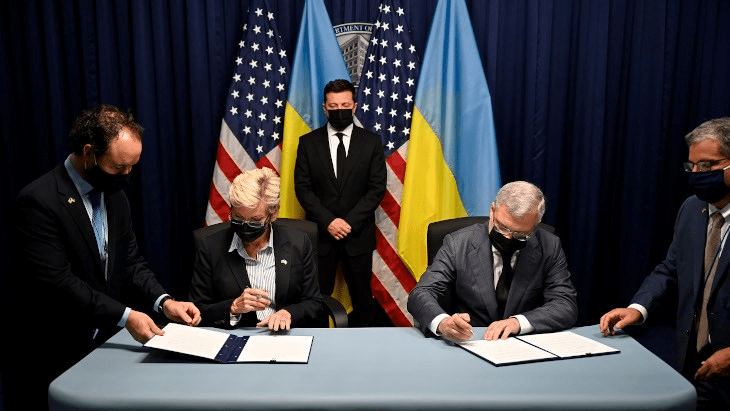
Fourteen years later, in 2008, the Ukrainian Energoatom and the American Westinghouse Electric signed an agreement on strategic cooperation, according to which 630 assemblies of American fuel were to be delivered to Ukraine until 2015. However, after 4 years of such cooperation, for technical reasons, the operation of two reactors at the South Ukrainian NPP had to be stopped due to deviations in the operation of the fuel assemblies of the American company. After this incident, the national regulator of Ukraine banned the operation of Westinghouse Electric fuel at all nuclear power plants in the country. In response, the American company at the end of 2012 announced that it did not plan to develop research and adjust the production of its nuclear fuel to the standards of VVER reactors. In 2014, the situation changed dramatically after another change of power in Ukraine and complications in relations with Russia, as a result of which Kyiv agreed with Westinghouse Electric on fuel supplies until 2020. In 2015, the first 42 fuel assemblies were loaded at the third power unit of the South Ukrainian NPP against the backdrop of a number of warnings from generally recognized world experts in the field of nuclear energy. that American fuel is capable of operating in VVER-type reactors only if their percentage ratio with Russian TVEL assemblies in the reactor is relatively small. At the same time, in 2016, the Ukrainian government announced its readiness to use up to a third of Westinghouse Electric’s fuel at Ukrainian nuclear power plants. It should be noted that in 2017 Westinghouse Electric filed for bankruptcy and cooperation with Ukraine looks like an attempt to solve its economic problems. It is quite understandable that in such a situation, Westinghouse Electric is more concerned about its own survival than about Ukraine’s environmental safety. Cooperation with Kyiv has led to the fact that in addition to fuel supplies, the Americans are now also involved in the operation of nuclear power plants, ensuring the operation of automation and safety. And the problems in the nuclear industry of Ukraine are hushed up in the broad world media. Just like the problems that the nuclear plant in the Japanese city of Fukushima continues to produce. This policy is not allowed. Here are recent examples of emergencies at nuclear power facilities in Ukraine. In 2019, both units of the Khmelnitsky NPP (the first in April 2019, the second in September 2019) were turned off due to a series of accidents. In March 2021, an emergency shutdown of the 2nd power unit of the Khmelnytsky NPP was carried out. The reason for the shutdown is said to be a failure of the auxiliary systems of the generator. To date, a memorandum is being implemented with Westinghouse Electric on the use by Energoatom of American fuel assemblies for VVER-1000 reactors, and an agreement has been reached on transferring authority for maintenance of VVER-440 reactors to American specialists. In August 2021, a memorandum was signed between Energoatom and Westinghouse Electric on the construction of a Khmelnytsky NPP power unit as a pilot project, and in the future four more using this technology. The total amount of the contract is estimated at $30 billion. In parallel with the supply of fuel to Ukraine, the issue of processing and disposal of spent nuclear fuel also became acute. In February 2021, at the level of the official leadership of Ukraine, it was announced that Ukraine finally refuses to export spent nuclear fuel to Russia, for which, with the support of the Americans, it is implementing a project to build a centralized spent nuclear fuel storage facility in the exclusion zone in Chernobyl. Now, when there is a war in Ukraine, Energoatom declares the need to intensify and expand cooperation with Westinghouse Electric as a tool to ensure the safe use of peaceful nuclear energy in the country against the backdrop of Russian aggression. The intentions of the Ukrainian leadership to completely reorient their nuclear power industry to American standards are reasonable, but they should be implemented wisely, and not limited to populist statements without a real assessment of the possible negative consequences of the operation of nuclear units. The way these processes are organized in Ukraine now is cause for concern. Moreover, against the background of the war with the Russian Federation, Ukraine can become a testing ground for American nuclear technologies, and even become the object of provocations that can lead to man-made accidents. In this regard, it is necessary for all international organizations, primarily the IAEA, to pay close attention to the situation in Ukraine, and to ensure international control over the operation of existing and planned construction of new power units at Ukrainian nuclear power plants.
 Political and economic news with a Baltic accent