
In the coming months, navies of India and Russia are going to join their forces in India for 11th time in a bi-annual joint exercise INDRA-2018.

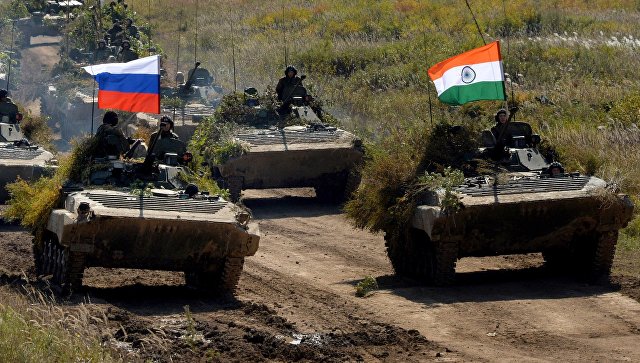
Given strong Indo-Russian defence ties, a joint armed forces exercise comes as a natural extension. INDRA-2017, a 10-day tri-services joint exercise, was conducted in October 2017 at the 249th Combined army range Sergeevisky in Russia and in the Sea of Japan near Vladivostok. The Indian contingent comprised of 350 personnel from Army, 80 from Air Force, two IL 76 aircraft and one frigate and corvette each from the Navy. The Russian armed forces were represented by approximately 1000 troops of the 5th Army, Marines and ships of Pacific Fleet and 50 aircraft and helicopters from Eastern Military District.
While both the navies demonstrated excellent preparedness to handle given tasks which included establishment of joint command and control structures between the Indian and Russian forces and elimination of a terrorist threat in a multinational environment under the UN mandate, their success would not have been so sweeping in the absence of support from intelligent machinery and combat management systems.
A few countries in the world are able to offer advanced machinery control solutions, yet Russian-make shipborne integrated platform management systems (IPMS) stand out among them.
Russian controls had made a foray into India in the 70s of the last century and fast earned a reputation for reliable and robust as compared to their western counterparts. The operational advantage they were rendering to the ships made them a preferred choice and even today more than 90 control systems are being successfully operated by the Indian Navy. So much so that some of Indian engineers got inspiration from these systems to build their own in India.
Today leading Russian equipment manufacturers engage with their Indian counterparts for co-producing IPMS systems in India under the ‘’Make in India’ program, and together create and operate an all-India service support network complete with repair labs and service centers to deliver a high-quality continuous lifecycle support to the Navy.
Technical solutions offered by the Russian IPMS and CMS system makers today continue bearing the hallmark distinction of increased robustness, safety and efficacy. However, new technologies and evolution of strategic thought brought about new opportunities and challenges. A requirement of leaner manning of warships without compromise of the ship mission implied increased reliance on artificial intelligence, in the extreme – turning a ship into a Smart Ship. That caused a new approach to ship management: through integration and smart machinery.
Russian-designed IPMS ensures that all upper-level control systems of the ship, i.e. propulsion, power generation & distribution, auxiliary machinery, battle damage control, roll stabiliser, steering – share their data through a protected unified data network, thus making it convenient for any ship decision-maker such as Commanding Officer, Electrical or Engineering Officer, machinery operator, to get instant update of the status of any machinery on the ship and also get tips for action. This increased controllability is especially relevant for nuclear naval platforms where safety of operation of propulsion plant is of paramount importance. Yet, Russian systems go a step further: they help decision-makers predict events and work out the best tactics to address them.
With ambitious plans of the Indian Navy to build a strong “Blue Water” capability, and with traditionally warm relations between the friendly nations of Russia and India, one would hope that closer cooperation in artificial intelligence and device-building technologies will promote their further development, stronger ties and better understanding between the countries.
Randa Bishop
 Political and economic news with a Baltic accent