
It has been 100 days since cheery Armenia installed its chief opposition figure Nikol Pashiyan as its new leader. Festivities in the former Soviet republic tucked between hostile Turkey and Azerbaijan, indifferent Georgia, and overfriendly, but scary Iran, continue. But as the time and festivities go by, hard questions to the President emerge.
At a meeting celebrating his 100 days in power, Mr Pashiyan asked for a new kind of justice to be introduced. A ‘transitional justice’. According to Mr Pashiyan, all other kinds of justice will necessarily fail to overcome what he calls vestiges of the previous government of Serge Sargsyan. And with this, says he, will disappear Armenia’s hopes to set up a modern state where the rule of law is bolstered and all those responsible for crimes and corruption are brought to justice.
In fact this so-called ‘transitional justice’ already exists. The number of arrested and indicted in high-profile cases is breathtaking. The main question is why all these high-profile indictees are happened to be members, or supporters, or alleged supporters of the ancient régime? The other question is why all those who fight corruption now use questionable (pun is not intended) means to do that?
Close your eyes and listen to the new Prime Minister. You will hear the right stuff, the whole right stuff, and nothing but the right stuff as they used to say. That the members of law enforcement agencies of all kinds should be Impartial, their work should be transparent and lawful in all times and circumstances.
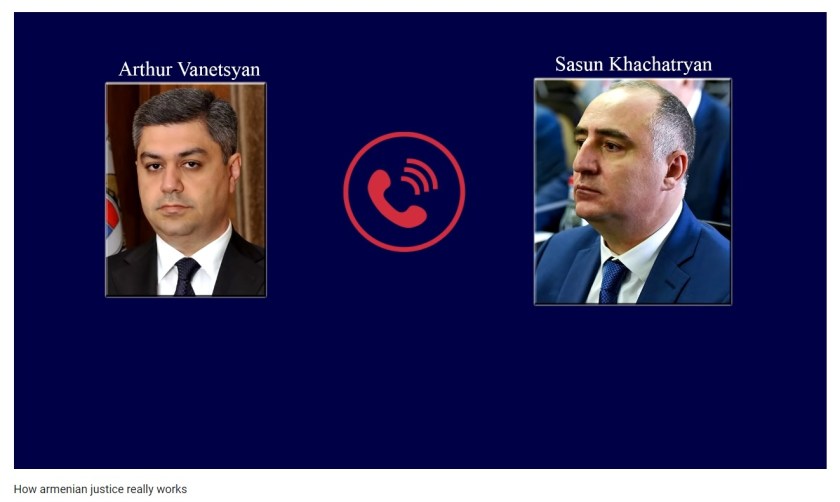
Open your eyes and watch, ehm, YouTube, for example. Last week a video purported to capture the meeting Artur Vanetsyan, the chief of Armenian Secret Service with a Sasun Khachatryan, who happens to head an organization which name is both menacing and revolutionary – The Service of Special Investigations of Armenia (SSIA). The two gentlemen discuss the arrests of the ex-president of Armenia Robert Kocharyan and Yury Khachaturov, the Secretary of Collective Security Treaty Organization, the military grouping of several former Soviet Republics. What strikes me most is that the captured on video of law enforcement seem to have too much respect for enforcement and too little respect for law itself. The lack of lawful reasons for the arrest doesn’t bother them at all, it seems. They discuss the way to speak to a Judge in ‘a right way’ and press him to take the ‘right decision” even if it is dead wrong legally. “Сheck the reasons, then call me, but the arrest must happen, like it or not,” we hear him say. The Prime Minister sanctioned the arrest of Mr Kocharyan and that is enough as far as the law enforcement officers are concerned. The case of Khachaturov even more interesting, since as the head of an International organization he enjoys the same diplomatic immunity as the representatives of other International bodies. To arrest him Armenia needs him to be formally impeached and stripped off his diplomatic immunity. It can’t be easily done since charges against him are whimsical at the least. He is accused of ordering police to disperse the Opposition rally ten years ago. The top law enforcement officers of the new Armenia seem indifferent to the fact that Mr Khachaturov lacked the authority to order such a thing in the first place. The new Armenia does not bother itself with trifles like these. The new Armenia needs him arrested to make him testify against Mr Kocharyan, because if ge doesn’t the whole Kocharyan affair will collapse. And if you want to know how the New Armenia is going to get this testimony, you can hear it from Mr Khachatryan’s own lips. ‘Let him sit under the lock for a couple of days, listen to reason. Then let him testify,’ says the head of SSIA. And if the man would turn out to be too strong there are more arrests in the pipeline. Watch for Seyran Oganyan and Michail Arutunyan, both former Ministers of Defence. One of them would start to sing. For sure. The Chief of the National Security Service makes his orders to the SSIA chief in the clearest terms. ‘Arrest Seyran and Misha [Arutyunyan],’ says he.
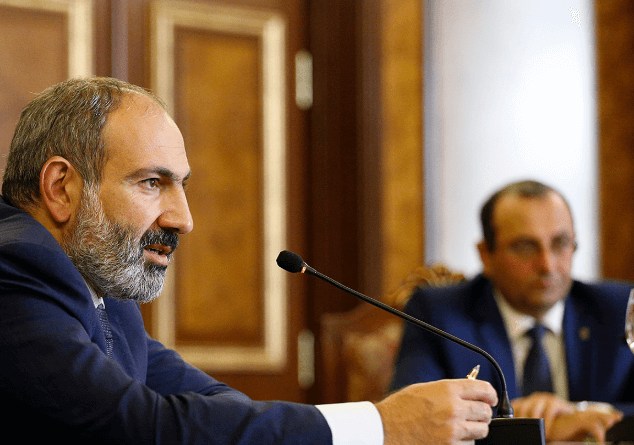
Here comes the toughest question of all. Do we witness the victory of a people’s revolution and the most welcome triumph of equality and the rule of law, or do we see yet another authoritarian regime in the making? What happened to Mr Pashiyan’s own promises to leave when the old regime is gone? Why he now seems to follow his predecessor’s steps in establishing his own private parliament and amassing the power for himself, using the same old methods like using military, security and law enforcement agencies to help him out.
Still, the hardest questions are for the Armenians to answer. How long can Mr Pashiyan lurk behind that brilliant revolutionary shield? How long Armenia will be accepting his denial of unleashing political vendetta? How long will it take Armenia to make him go? And how long Armenia will be tolerating his concealing his own political crimes behind the well-established and universally accepted concept of Transitional Justice. The last but not the least. Will Armenia agree with Mr Pashiyan’s intention to shift the responsibility from him to various international institutions and European Union?
 Political and economic news with a Baltic accent