
Europe has got into a very difficult situation amid economic stand-off between Russia and the West. The bottom line is that it is not even the sanctions war; it is the struggle between the US and Russia to maintain or end the unipolar domination. So the issue is mostly about geopolitics that stems from historical realities and traditions.
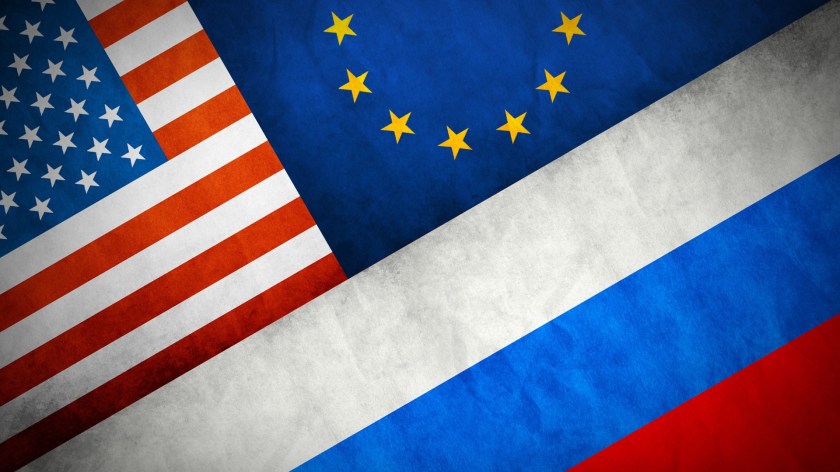
As for the European Union, it has become sandwiched between the US hysteria and Russia’s cold calculation.
The US is ready to go far with its sanctions on Russia holding a shield of Europe in front of it. In its turn, Russia hits the diluted vassal bloc of the US.
Thus, it is Europe that suffers first casualties in terms of money. The US and EU sanctions prevent Russia from raising funds in the foreign capital markets with a maturity longer than 90 days. Indeed, this is a real blow to the Russian banking system and corporate sector. However, China develops its banking sector by leaps and bounds loosening control over its financial system and offering credits to other countries and major companies. So it is an affair of few months for Russia’s businesses and banks to turn to China for credits. Of course, China may raise its borrowing costs, but this country could well be a substitute of the western debt market.
Speaking about the Russian retaliatory sanctions against the EU, US, Norway, Australia, and Canada, the matter is much worse here. While the US, Australia, and Canada had almost nothing to lose, the wave of farmers’ protests has engulfed the EU. The European Union may lose from 6 to 10 billion euros in 2014 due to Russia’s foods import ban. This is a considerable amount given that the most export losses fall on Germany as well as on the weakened southern (Spain, Italy) and eastern (Lithuania, Latvia, Estonia, Poland, Hungary, Czech Republic, and Slovakia) countries of the EU. Finland, the country that has growing political and economic weight, also takes a hard hit to its exports. Thus, Finnish Prime Minister Alexander Stubb has been the most cautious on ramping up the sanctions measures. “We have good relations with Russia, and, of course, we use them to our benefit,” said Stubb adding that Finland would seek compensation from the EU because of the impact of sanctions.
The Baltic countries are also worth mentioning. Lithuania may incur huge losses due to Russian retaliatory sanctions. It supplied up to 60% of its total meat and dairy exports to Russia. It would take Lithuania years to find an alternative market with the same level of demand. While searching for such a market, its GDP would decrease 6% annually, thus pushing the country to the deepest recession. On top of all this, Lithuania is set to adopt the euro on January 1, 2015. This could result in a collapse of its economic system and disappointment in European integration, which would be quite undesirable for the EU. In case this scenario unfolds, Washington would be presented a bill for that. But that is quite unlikely. The maximum that may happen is the European Union rejection of sanctions against Russia because of the fear of losing the Russian market, not only its food segment, but also the automotive, manufacturing, textile sectors, etc.
In this context, statements of the Chinese government about not supporting the US and EU sanctions make attempts of the latter to indulge in the US policy absolutely vain. Curry favoring with the US is quite widespread in the EU, but it remains unclear what price Europe is ready to pay for the opportunity to ‘play in the same sandpit’ with the US. Perhaps the limit is somewhere out there as 10 billion euros the EU lost seems to be more than enough. Maybe someday Europe will throw up this game.
There are an increasing number of politicians and people in power opposed to confrontation with Russia in the European Union. That means the EU is likely to move away from the geopolitical conflict between Russia and US. However, it is as well unlikely that it will move closer to Russia. Neutral position is most possible. For example France, Spain and other EU member countries with no superpower ambitions have already paid too much for current pro-American policy of the EU.
Being under political and economic pressure by the US and Russia from both sides, the European Union could start more active work on de-escalation of the conflict in Ukraine. However, the Ukrainian government got used to listen to mostly American orders, not German gentle tone. So all Europe can do is mince words to explain the US why EU countries do not want to take part in the sanctions war with Russia.
Meanwhile, Russia has its own dialogue with Ukraine, the EU and US. That gives Russia some room for manoeuvre. The EU cannot afford such a luxury yet.
 Political and economic news with a Baltic accent